Category Archives: Uncategorized

The Virgin

I have written of becoming a mother of God, through hearing the Word and obeying the Father. This is a great privilege, a holy labor, an abundant joy.

Yet it is nothing like being the Mother of God, the Holy Virgin. I know that I shall never become like her – I am nowhere close.

It has been said that Jesus told us that we can all be His mother and sisters and brothers because He wanted to make it clear that the essential relationship lie not in biological ties. Rather, the spiritual bond – the profound intimacy of being brought into Jesus’ union with the Father and the Spirit – is the true blessing.

And so it is.

The reason I can say I will never be like the Holy Mother of God is because I will never be as completely obedient as she was, as completely giving of my entire self to God.

I have already failed that test. And yet I do not despair.

What is so incredibly beautiful is that we have been given Holy Mary to be part of our family too. Because of what she gave, she carried the Lord God within her – not just physically in her womb, but in the depths of her heart.

She is “Theotokos” not just because she gave birth to Jesus in time, as incredibly important as that was, but because she brings Him to birth throughout time, in all parts of the world, in every race and culture.

It is for this reason that we can rightfully portray the Madonna in art with any racial features – or rather with all racial features – because she is Mother of all.

At one time, all of this seemed very strange to me and I had a difficult time understanding what seemed to me an almost cult-like devotion to the Virgin that I saw in some countries. And certainly, as with any matter of faith, there may be people who slip into the extremes, innocently or not so innocently, and for many reasons.

But the Virgin Mary is given to us to help and protect us. We must never forget that the war of the spirit rages around us and within us – and we cannot fight it alone.

The Theotokos has been given many designations that tell us how very important she is in our Christian life, e.g. Mother of Mercy, Help of Christians, Refuge of Sinners, Seat of Wisdom, Cause of Our Joy and Queen of Peace, among many others.

The Holy Virgin has also been known by the places where she has appeared to humble believers. While some of these appearances may be controversial, some are utterly awesome in their nature and impact.

Today (December 12), we in the Western Church celebrate one such appearance of the Holy Lady to a peasant named Juan Diego. The year was 1531, the place was Mexico.

In the event that you are not familiar with the account (or would like to hear it again), I have narrated it and will reprint the text below, before commenting further.


Text: From a report by Don Antonio Valeriano, a Native American author of the sixteenth century

At daybreak one Saturday morning in 1531, on the very first days of the month of December, an Indian named Juan Diego was going from the village where he lived to Tlatelolco in order to take part in divine worship and listen to God’s commandments. When he came near the hill called Tepeyac, dawn had already come, and Juan Diego heard someone calling him from the very top of the hill: “Juanito, Juan Dieguito.”

He went up the hill and caught sight of a lady of unearthly grandeur whose clothing was as radiant as the sun. She said to him in words both gentle and courteous: “Juanito, the humblest of my children, know and understand that I am the ever virgin Mary, Mother of the true God through whom all things live. It is my ardent desire that a church be erected here so that in it I can show and bestow my love, compassion, help, and protection to all who inhabit this land and to those others who love me, that they might call upon and confide in me. Go to the Bishop of Mexico to make known to him what I greatly desire. Go and put all your efforts into this.”

When Juan Diego arrived in the presence of the Bishop, Fray Juan de Zumarraga, a Franciscan, the latter did not seem to believe Juan Diego and answered: “Come another time, and I will listen at leisure.”

Juan Diego returned to the hilltop where the Heavenly Lady was waiting, and he said to her: “My Lady, my maiden, I presented your message to the Bishop, but it seemed that he did not think it was the truth. For this reason I beg you to entrust your message to someone more illustrious who might convey it in order that they may believe it, for I am only an insignificant man.”

She answered him: “Humblest of my sons, I ask that tomorrow you again go to see the Bishop and tell him that I, the ever virgin holy Mary, Mother of God, am the one who personally sent you.”

But on the following day, Sunday, the Bishop again did not believe Juan Diego and told him that some sign was necessary so that he could believe that it was the Heavenly Lady herself who sent him. And then he dismissed Juan Diego.

On Monday Juan Diego did not return. His uncle, Juan Bernardino, became very ill, and at night asked Juan to go to Tlatelolco at daybreak to call a priest to hear his confession.

Juan Diego set out on Tuesday, but he went around the hill and passed on the other side, toward the east, so as to arrive quickly in Mexico City and to avoid being detained by the Heavenly Lady. But she came out to meet him on that side of the hill and said to him: “Listen and understand, my humblest son. There is nothing to frighten and distress you. Do not let your heart be troubled, and let nothing upset you. Is it not I, your Mother, who is here? Are you not under my protection? Are you not, fortunately, in my care? Do not let your uncle’s illness distress you. It is certain that he has already been cured. Go up to the hilltop, my son, where you will find flowers of various kinds. Cut them, and bring them into my presence.”

When Juan Diego reached the peak, he was astonished that so many Castilian roses had burst forth at a time when the frost was severe. He carried the roses in the folds of his tilma (mantle) to the Heavenly Lady. She said to him: “My son, this is the proof and the sign which you will bring to the Bishop so that he will see my will in it. You are my ambassador, very worthy of trust.”

Juan Diego set out on his way, now content and sure of succeeding. On arriving in the Bishop’s presence, he told him: “My lord, I did what you asked. The Heavenly Lady complied with your request and fulfilled it. She sent me to the hilltop to cut some Castilian roses and told me to bring them to you in person. And this I am doing, so that you can see in them the sign you seek in order to carry out her will. Here they are; receive them.”

He immediately opened up his white mantle, and as all the different Castilian roses scattered to the ground, there was drawn on the cloak and suddenly appeared the precious image of the ever virgin Mary, Mother of God, in the same manner as it is today and is kept in her shrine of Tepeyac.

The whole city was stirred and came to see and admire her venerable image and to offer prayers to her; and following the command which the same Heavenly Lady gave to Juan Bernardino when she restored him to health, they called her by the name that she herself had used: “the ever virgin holy Mary of Guadalupe.”

There are a number of things about this appearance that are utterly amazing and deeply moving. One is that the “heavenly Lady” spoke to Juan Diego in his native language and insisted on speaking through this most humble but faithful man.

The image she left of herself on his mantle showed her in Aztec clothing, using symbols that could be readily understood by the Aztec people. A shrine was built on the hill where she requested it and, within 7 years, approximately 9 million Aztecs were converted to the faith.

The image she left has many remarkable qualities and it seems to be essentially indestructible. A strong nitric acid solvent was accidentally spilled on a large part of the image in the late 18th century and it “self-restored” over the next month. In 1921, a bomber placed 20 sticks of dynamite before the tilma in its glass case. Virtually everything around it was destroyed, including a marble altar rail, but the tilma and its case remained intact. 

Fascinating studies have been done of the image, revealing things that seem impossible – if we were not believers. For example, it has many qualities that are very much like a human body (it maintains a temperature of 98.6 F).
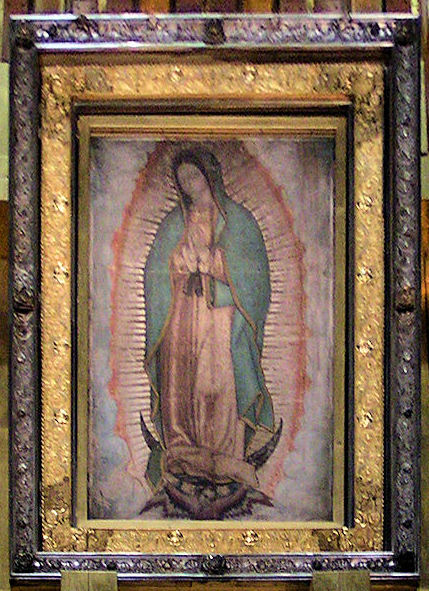
                  actual image as displayed in shrine (borrowed from Internet)

However, more important than these fascinating details is that there is an enormously powerful truth among us.

It is called the Kingdom of God.

And its presence was made possible because one young woman, a humble virgin, said “yes” and gave all, out of loving obedience.

She is our Mother. May we accept her loving help as we learn to be mothers of God, each in our own little way.
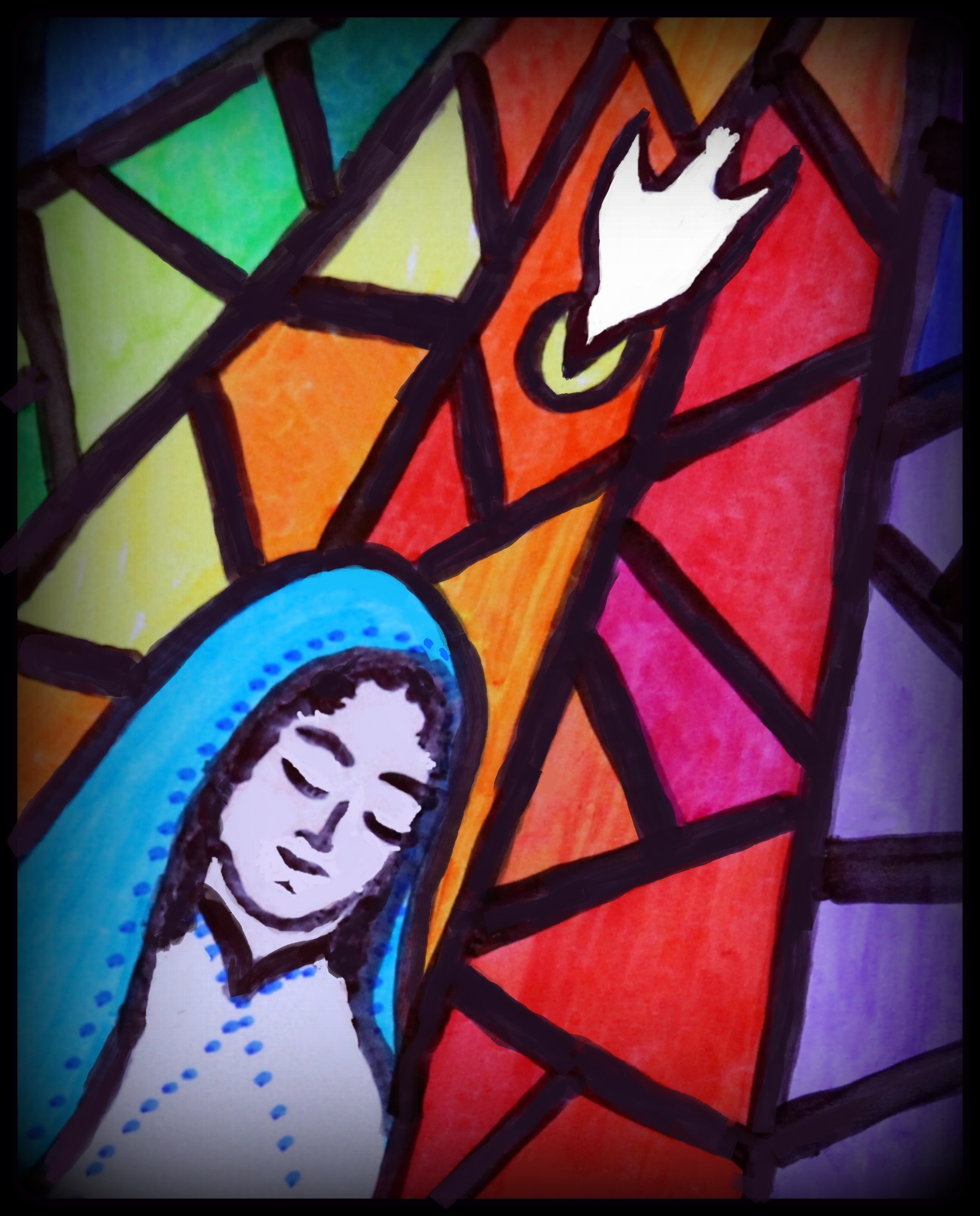
On becoming His family

“May I bear your pain?”

“Allow me to carry your suffering for you…”

These are not my words but those of the Lord Christ. Although they were never historically recorded for us, they make themselves evident throughout the Gospel stories of Jesus’ encounters with people at every level of society.

I hope that someday they will be my words.

My mind seems relentlessly drawn back to our Scripture passage about being a mother of Christ – or a brother or a sister. To be so close to Him – to be welcomed into His immediate family – such joy!

We are told that if we do the will of the Father, we are mother and brother and sister to Him. This makes complete sense. If we do not love our Father enough to respect and obey Him, we are not ready to be family with Him.

All of us have grown up with less than perfect families – it is part of being human. Even the best of human families are made up of sinners and most of us have not had (or been) the best.

Thus, it is impossible for us to fathom just what it means to be invited into family with the Lord. It certainly must be something far beyond anything we can imagine.

I wonder why I try to write of something I cannot understand. Perhaps because there has been implanted in me (and all of us) a longing for complete and eternal Home. A Home where, as family of Christ, we are so “related” that we are Body together.

We do not live in such a Home alone, any more than the organs of a body function apart from one another. Rather, we support each other so intimately that separation is incomprehensible.

Such a Body is possible only with Christ as our Head. Such a Home is possible only with God as Father of all.

+

If I might, for a moment, return to the words of St. Porphyrios that I recorded in my last post, he referred to “commingling of the soul with the divine”. Or as is stated in 2 Peter (ch. 1), Christ has bestowed great promises on us that we “may come to share in the divine nature”.

This is particularly intriguing because generally we think of mothers (and fathers) giving their life and nature to their children. But here, as we are invited to be mothers of God, His nature is given to us.

As He is born, we are re-born. We are made glorious in Him. Yet we can only “give birth”, bringing others into the Body, because birth was first given to us.

Despite this promise of glory, we must never forget that giving birth is inevitably a painful process.

The love which gives birth, the love which makes us “mother” to Christ, is that love which reaches out to take the pain of another, to carry his suffering, to hold her sorrow, with profound compassion.

It is not a social policy. It is not a charitable donation. It is my life-blood, offered for the other.

If I am to be “mother of God”, my soul commingling with the divine (I pray it be so!), I must be ready to spill every drop of that life-blood to make it happen.

I cannot accept birth or give birth without labor, the emptying of myself.

I cannot live in Body and not live as Body. My self can only offer all that it is for the healing and health of us all.

My cells cannot be more important than other cells. Nor can they have their own agenda or declare their functions to serve some and not others.

I cannot be in family, in Home, and disobey. I have a Father and only in Him, in His love, with the truth and wisdom of His Spirit, can we be eternal Home together.

This is the life that I long for. This is the life for which we were made.

I am not good enough or strong enough to do any of this, of course.

But He comes – no, He is here – and He shares with me His very nature.

May I bear your pain? Allow me to carry your suffering for you…

Amen. Let it be so.

(Today is the one year anniversary of the beginning of this little blog. Thank you, dear readers, for supporting me here. Let us pray for each other as we allow ourselves to be led by God.)

Wounded

Today, December 2, is the feast of St. Porphyrios of Kafsokalivia whom I can quite honestly say I love. Although I never met him during his lifetime, when I read his words, I immediately feel close to his heart. Perhaps it is because we are both in love with the same One.

Although I am late in doing so, I wanted to post a little something in praise of the One we love for his feast day. Because he famously penned the words, “Whoever wants to become a Christian must first become a poet”, I could not help but ask God if I might have a little poem for the occasion.

Until just now, as I was about to post the poem, I had not remembered exactly these words that follow the well-known quote: “That’s what it is! You must suffer. You must love and suffer – suffer for the one you love. Love makes effort for the loved one.” (p. 107) And so it is…

(now for the poem God provided:)


pierced,

stab of sorrow,

pounding nails,

o heart of mercy –

i will never be the same.

i never want to be the same –

only to bleed love

for the wounds

that are your anguish.

“take me,

take me –

i cannot remain outside!”

the pain is all i have

to give, o heart,

and so i give,

i give –

i give it all

(until i am no more)

o mercy,

my endless mercy,

lost in your love.

+++

I have also recorded for you a brief excerpt from the writings of St. Porphyrios, as found in the book, Wounded by Love, pp. 126-127.


On becoming a mother of God

IMG_0986-2

Me, a mother of God, a mother of Christ the Savior?

The notion seems absurd. And it is absurd, if we only consider the meaning in the bodily sense. I will never carry the Son of God in my womb as did the Virgin.

Yet the Lord Himself told me I can be His mother in an even more important way. And He has said the very same thing to you.

Before I comment further, let us hear how St. Augustine explained these words of Jesus: (if you prefer to read rather than listen, the text is printed in blue below).


Text: from a sermon by St. Augustine, Bishop

Stretching out his hand over his disciples, the Lord Christ declared: Here are my mother and my brothers; anyone who does the will of my Father who sent me is my brother and my sister and my mother. I would urge you to ponder these words. Did the Virgin Mary, who believed by faith and conceived by faith, who was the chosen one from whom our Savior was born among men, who was created by Christ before Christ was created in her –- did she not do the will of the Father? Indeed the blessed Mary certainly did the Father’’s will, and so it was for her a greater thing to have been Christ’’s disciple than to have been his mother, and she was more blessed in her discipleship than in her motherhood. Hers was the happiness of first bearing in her womb him whom she would obey as her master.

Now listen and see if the words of Scripture do not agree with what I have said. The Lord was passing by and crowds were following him. His miracles gave proof of divine power, and a woman cried out: Happy is the womb that bore you, blessed is that womb! But the Lord, not wishing people to seek happiness in a purely physical relationship, replied: More blessed are those who hear the word of God and keep it. Mary heard God’’s word and kept it, and so she is blessed. She kept God’’s truth in her mind, a nobler thing than carrying his body in her womb. The truth and the body were both Christ: he was kept in Mary’’s mind insofar as he is truth, he was carried in her womb insofar as he is man; but what is kept in the mind is of a higher order than what is carried in the womb.

The Virgin Mary is both holy and blessed, and yet the Church is greater than she. Mary is a part of the Church, a member of the Church, a holy, an eminent -– the most eminent -– member, but still only a member of the entire body. The body undoubtedly is greater than she, one of its members. This body has the Lord for its head, and head and body together make up the whole Christ. In other words, our head is divine -– our head is God.

Now, beloved, give me your whole attention, for you also are members of Christ; you also are the body of Christ. Consider how you yourselves can be among those of whom the Lord said: Here are my mother and my brothers. Do you wonder how you can be the mother of Christ? He himself said: Whoever hears and fulfills the will of my Father in heaven is my brother and my sister and my mother. As for our being the brothers and sisters of Christ, we can understand this because although there is only one inheritance and Christ is the only Son, his mercy would not allow him to remain alone. It was his wish that we too should be heirs of the Father, and co-heirs with himself.

Now having said that all of you are brothers of Christ, shall I not dare to call you his mother? Much less would I dare to deny his own words. Tell me how Mary became the mother of Christ, if it was not by giving birth to the members of Christ? You, to whom I am speaking, are the members of Christ. Of whom were you born? ““Of Mother Church”,” I hear the reply of your hearts. You became sons of this mother at your baptism, you came to birth then as members of Christ. Now you in your turn must draw to the font of baptism as many as you possibly can. You became sons when you were born there yourselves, and now by bringing others to birth in the same way, you have it in your power to become the mothers of Christ.

These are powerful words indeed.

I’m sure the words of Jesus in St. Augustine’s sermon have been preached about in many different ways throughout the centuries. But what has struck me about them just now is how very flawed my thinking has been.

If you are a regular reader, you may recall that my word for 2015 is “chasten”. Although one might expect, with a word like that, I’d be heaving a sign of relief that the year is almost over.

Actually I’m not.

I’ve rather come to like this little word that chose me. It is a wonderful and refreshing thing to be chastened by our loving God – to have Him point how wrong and stupid has been my thinking so that I can start to work on some genuine repentance and growth.

Anyway, about my current chastening. When I encountered these words of Augustine about being a mother of Christ, I realized that I wasn’t making much effort in this area at all.

Oh, I’ve been working on doing the will of the Father – clearly no small task and certainly not done flawlessly. But the part I really haven’t been doing is bringing as many others to birth as possible.

In my “coming of age” during the late ’60’s and early ’70’s, I grew up with a radical consciousness of how recklessly Western “Christianity” forced itself on other cultures, stripping them of their dignity and sometimes their lives. In my outrage against such injustices, the Native American people were primary in my awareness.

I developed a mindset that we should not try to push our faith on others. Period.

It was not that I didn’t think that Christianity was worth sharing but, in my mind, I couldn’t separate the notion of evangelization with cultural rape. What had been done to these beautiful peoples of God in the name of Christianity was nothing less.

Along with that, my understanding of evangelization during young adulthood became contaminated with an experience of evangelical Christianity that was limited to being accosted on street corners by insistent youth who had to know if I had been “born again”. It was never enough that I was a Christian.

I include this background by way of explanation rather than excuse. Looking back, I now see how I came to the erroneous view that it is best to simply respect people where they are and make no attempt to bring them to the Christian faith.

There’s nothing erroneous about respecting people where they are, of course. It’s the second clause in that sentence that is the clincher.

Our adversary is very clever. He can make doing the wrong thing seem so much like doing the right thing, just by putting two phrases together like that. And I fell for it. For a very long time.

No more. I want to be a mother of Christ.

+++

I took a break from my writing and now I am back. I realized that there is one very important point that I must clarify.

It is a good thing that the Kingdom of Heaven does not depend on people like me getting it right.

I say this because I am well aware that God in His goodness has very likely made use of me to help bring people to Him. If I am genuinely trying to do the will of the Father, all of my wrong thinking and personal weaknesses are not going to stop the powerful words Jesus gave us to pray, “Thy Kingdom come…”

It will come. It is coming. It is here among us.

But this makes it all the more urgent that I wake myself from the sleep of my spiritual sloth and recognize that, indeed, I must bring as many as I can to the font to be born as members of the Body of Christ.

Not only is it my duty – it is my joy – as it is the joy of a mother to bring children into the world.

It is also not easy. It is not easy in today’s world to know how to do this.

Approaching strangers on street corners is certainly not the place to begin. To bring others does not mean to pressure them. But what is it I am to do then?

Because I do not know and cannot know, it is one of those occasions when it is good to remember that we have been given the Spirit who teaches us all things.

Perhaps the most simple and obvious of His instructions is to pray.

I am not to pray with the attitude of one who thinks herself in a superior position. Remembering that the Church is a hospital for the sick, I must always be mindful of the meaning of my membership. To remember others prayerfully, to ask God to send them the grace to find their way, is to ask that they come to know the healing that I myself am still experiencing.

My friend in heaven, St. Thérèse of Lisieux, gives me great inspiration and encouragement in bringing souls to Christ. While prayer may be the words I say, she also reminds me that every little sacrifice or suffering becomes a prayer when embraced out of love. She brought many to God in this manner, her “little way”, without ever stepping outside of her convent.

In many other wordless ways the Spirit instructs. For much of what we are to do is wordless. It is not that words are of no value but rather that love speaks much more clearly and to the heart.

If I tell someone what brings me joy and peace, it will mean little to them. If I tell them that I have a faith based on love, it will count for nothing. But if they observe me living a deeply peaceful life of joy they will wonder. If they feel loved by me in way that makes no sense to them, they will want to know where this comes from.

They will want more of this experience. They will want to know more about the Body that lives this way. They will want to become part of that Body.

A beloved patient of mine, now deceased, used to say, I want what you have. She struggled mightily over faith – but I believe she now has what I have and more. Much more.

So, if the Lord has allowed me to be His mother even when I was so oblivious and resistant to His call, how much more may He make use of me now that I am coming awake?

It is now the time of preparation, the time we ready ourselves to more deeply understand and celebrate the Birth that changed everything. It is a time of awakening.

But it is more than just another Advent season leading up to another Christmas. It is a time in which the world is so full of darkness that we can only dream of light, so full of hate that we can barely remember peace.

It is a time to sit in the darkness resolutely, with hope, until we see the Light.

It is the time to become a mother of God…

my King

(As the Feast of Christ the King draws to a close…)

Let me tell you a few things about my King.

He is not like the other kings you read about in history or story books. He does not sit on a big throne of gold and command vast armies in war. He does not have huge coffers of riches that he uses to control other people. He doesn’t even demand that everyone bow before him. He does not live in a big castle, high on a mountain where no one ever gets to see him.

He is a King who lives in my heart.

He is a King who comes and knocks on my door and, if I open it, He’ll come in and have supper with me.

(If I don’t open up, He’ll come and knock again. And again. He  doesn’t demand anything but He wants me to know that He is there, waiting to be allowed inside.)

He is very poor, having given me everything. And yet everything is His. I know that doesn’t make sense but I don’t know any other way to explain it.

He never tries to make me bow before Him or worship Him. He always wants to serve me. He asks to wash my feet as He sits on the floor before me. He quenches my thirst with a sort of Life-giving water that never runs dry. And He feeds my deepest hunger with Himself. I don’t quite understand how He does that – but He does.

And He has the most wonderful Father. The love between them is so amazing – I’ve never seen anything like it. My King and His Father are never apart from each other – so they both come in when I open the door. In fact, they have made their home within me. Now His Father is my Father too.

Some people might think that a King like this can’t be very powerful. But that is the strange thing about my King. His power is sweet and gentle but inexorable. He does no violence but there is no evil that can stand up before Him and win. Even death is destroyed by His presence.

That kind of power would seem scary – but in Him, it’s not. He does everything with Love. I never knew that Love could be that powerful but I guess it is.

I must say though, His Love is different than the other kinds of love you might read about or see in the movies. It’s hard to explain. Somehow it goes way deeper. It doesn’t expect anything back.

I don’t mean that He doesn’t want anything back because He does – He wants me and wants my love. But He would give His Love even if He didn’t get mine in return. And He wouldn’t hold anything back or resent it. He would die for love of me, even if I didn’t pay any attention to Him.

In fact, He already has. Another one of those things that’s hard to explain.

I’m so glad He’s my King. He doesn’t try to control me but I want Him to rule all of me. I trust Him to be in charge more than I trust anyone else. In fact, I’d rather have Him in charge than be in charge myself.

I love Him. I’m in Love with Him.

I know as I write this it sounds like I have my own personal King, living in my heart, attending to my every need. And it’s sort of like that. But, at the same time, I know He is everyone’s King and lives in their hearts – or is at least knocking on their doors.

And I’m glad. I’m excited that He is not just my King. Because when I meet someone else who has Him living in their heart, what joy we feel! In fact, there are whole groups of us who get together and sing and share Him and His Kingship in us.

Because I’m in love with Him, I’m in love with them. So the Love keeps growing and getting deeper – and it never stops.

It is just too beautiful for words.

I hope you know what I mean… but if you don’t, listen for the knocking. You’ll hear it.

Don’t be afraid. Just open the door…

A fallen season

I offer you this evening a little painting that bears a Haiku on its back.

This was not what I set out to do, of course, but that is what makes working with alcohol inks so very interesting. They often seem to tell me what needs to be painted rather than the other way around.

The ink on the paper then becomes a sort of Rorschach, bringing forth a tiny poem.

In this case, I had begun thinking that perhaps I should design a Christmas card for this year but my ink reprimanded me, reminding me that we are only now just approaching the end of the liturgical year.

Outside, most of the leaves and petals have dropped, leaving barren branches and stems. Birds peck old flower heads for remaining seeds that failed to escape and hide in nature’s compost.

It is not yet the season for a Birth. It is a fallen season…

IMG_20151119_0001

(I will also post a few autumnal images at oholyearth.com to further celebrate our fallen season.)

In this world of darkness

Is there anyone whom God does not love?

Is there anyone for whom Christ did not die?

I can only respond to these questions in the negative. No, there is no one. I must confess my faith that the Lord Jesus died as much for Hitler, Pol Pot and Idi Amin as He died for me.

And that He died for the members of ISIS, the Islamic terrorist group claiming responsibility for a recent act of bloody terrorism in Paris. And for their victims. And for the French officials who have now sent warplanes to bomb Syria.

He died for us all. We are all beloved of God, regardless of what we do or believe. We cannot change the God who is love, no matter how badly we sin.

I am not in the practice of writing political pieces on this blog and this is no exception. Although at one time I was a very political person, participating in demonstrations and writing letters to the editor, I have withdrawn from the political world.

I cannot have faith in politics. It asks the wrongs questions and inevitably chooses solutions that I cannot accept. I can only believe in God.

When I heard the tragic news of the acts of terrorism in Paris, of course my heart was deeply saddened for the victims and those who love them. Death, trauma and terror was imposed on them even though they, as individuals, had done nothing to provoke it.

Now, they or their survivors will be forever changed. What they once thought of as “life” will be never feel the same, will never feel normal or right again. A deep, deep tragedy.

Yet another thought occurred to me: which is more tragic – the injury and loss of life of innocent victims or the state of the souls of those who perpetrated these acts?

This may seem like an odd, even outrageous question. But, as Christians, we are often called upon to view our world from a radically different perspective.

Let us consider the admonition given us by the Lord:

“And do not be afraid of those who kill the body but cannot kill the soul; rather, be afraid of the one who can destroy both soul and body in Gehenna.” (Matthew 10:28)

We are to fear death of the soul far more than we should fear the death of the body. This being the case, should we not mourn even more for those who seem to have lost their souls than for those who have lost only their bodies?

Certainly we should pray for those injured and killed. But should we not be praying even more diligently for those who planned and carried out the killing?

It is not our natural human tendency to think so. Rather our inclination is to want to strike back, viewing such counterattacks as necessary to protect ourselves and perhaps “teach” the perpetrators that such acts will not be tolerated.

Yet Jesus tells us,

“But I say to you, love your enemies, and pray for those who persecute you, that you may be children of your heavenly Father, for he makes his sun rise on the bad and the good, and causes rain to fall on the just and the unjust.” (Matthew 5: 44-45)

The call to love our enemies is perhaps one of the most defining features of our Christian faith relative to other creeds, yet it is arguably the one teaching of Christ that we most chronically and publicly fail to obey.

Why is it that we Christians so consistently disobey Christ on this very fundamental issue?

Certainly there are numerous reasons, many of them rooted in our passions and the sins that emerge from them. Yet there is another reason, one that is perhaps even more pernicious.

We know that we who serve the Good cannot be passive and indifferent in the face of evil. We must resist it. And it is through this knowledge we have become seduced by the true enemy into fighting our brothers and sisters.

The world has always had its wars and people have gone off to fight them. Early humans living in caves fought with rocks and spears. Eventually human weaponry graduated to rifles and canons, then napalm and nuclear bombs.

Typically one side justifies hurting the other because of the “evil” done by their opponent. Then the favor is returned because of that “evil” act. And so on…

However, the Lord Jesus is, I believe, trying to teach us that this is the wrong war – and that we are using the wrong weapons.

The true war we are called to fight is the spiritual war and our common enemy is the evil one. Seen in this light, we and ISIS (and all other terrorists and despots throughout time) all have the same enemy, though we may not recognize it.

It is the evil one who shifts our vision away from all other people as God’s beloved children for whom He gave His Son. It is the evil one who seduces us into believing that our fellow human beings deserve to die – and that we should kill them.

If our brother or sister does wrong, we must pray – for we too are sinners who have done wrong. We know what it means to fall from the grace of God and our only desire should be to draw the other from the clutches of the enemy. Especially when we see that he has blindly gone over to the other side.

Yet the true enemy, our adversary, convinces us that our brother or sister is the enemy, not him. And so we are deluded into fighting the wrong wars with the wrong weapons – and these wars never cease.

The weapons of our war, the spiritual war we are meant to fight, are humility, repentance and confession, Eucharist, charity, prayer, fasting and compassion for all of God’s children. And most of all love.

It is love that sends the real enemy running. He cannot countenance it, knowing as he does that love is God and God is love.

Many might read these words of mine and think them naive or idealistic. Perhaps even traitorous.

“Using those weapons will never work with these kind of people,” is the automatic argument of human logic.

Yet if I do not believe that they work, if I do not believe the words of Christ Himself, how can I call myself Christian?

And calling myself Christian is all that matters to me.

In this world of darkness, we who believe must unite ourselves to each other as Church and to the Light who is Christ Jesus our Lord.

For it is by this Light that others shall see…

To Him be glory.

A saint?

It started late last night when I was listening to the Office of Readings (divineoffice.org) for today and was surprised to learn that it was the feast of St. John Paul II.

I must admit that his canonization, from the time I first learned of it, had left me with considerable unease.

I did not dislike this popular Pope. I was neither one of his detractors nor one of his great fans.

My discomfort came from how quickly he was canonized, relative to the usual occurrence in the Catholic Church, and my fear that he was perhaps being pushed through simply because he had been so loved by the people he served.

While it is wonderful that he was so loved, that certainly does not make him or anyone else a saint. It seemed to me that a declaration of sainthood by the Church should be reserved for those whose lives demonstrated an exceptional level of sanctity.

The second reading in the Office was from John Paul II’s homily when he was inaugurated as pontiff of the Roman Catholic Church. I found the audio version presented on the website harsh to my ears – I am admittedly critical of both my own and others’ reading – so, as I often do, I decided to record the passage myself.

I find that recording a narrative causes me to enter into its substance more deeply. I am not just reading but trying to interpret, with tone and phrasing, the intended meaning so that the passage might be better understood.

As I did that with this particular excerpt, I found myself becoming strangely emotional, indeed, near tears, toward the latter part of it. The then new Pope prayed of Christ’s “sweet power” and prayed that he might be a servant of that power “that knows no dusk”. (Images of him with advanced Parkinson’s disease flashed through my mind.)

Then, his plea, “Do not be afraid…”

I realized as I read this that I really didn’t know this man. I had rather quickly slipped into an uneasy opinion about his sainthood while knowing very little about him.

How many of his sermons and encyclicals had I read? The answer would shame me.

In the Catholic Church, canonization requires the documentation of at least two miracles attributed to the intercession of the servant of God under consideration. The process for documenting the miracles is very stringent for this purpose. (At times, I have thought this process bordering on ridiculous. On the other hand, it does lead to a confidence that a miracle has truly occurred. Under these guidelines, an occurrence of healing cannot be explained by hysteria or some such.)

I realized as I was reflecting on this man’s life that I didn’t even know what the second miracle was that led to his canonization. (I knew the first one was a healing from Parkinson’s disease.) I just looked it up. Pretty amazing stuff.

Of course, all miracles are from God. And all saints are sinners whom God has saved.

I debated about whether to post this recording and reflection, not wanting to offend my Orthodox friends who don’t recognize the papacy. And not wanting to rouse the ire of any who hold the Pope responsible for the horrible sex scandal among some of our priests.

All of these things are complicated matters for which I have no answers. In the end, I decided to post, in hopes that the words that so moved my heart might move the hearts of others in our common journey toward Christ.

May God be merciful to us all and help us become true servants of His sweet power, the power that indeed, “knows no dusk”.


[Text] From the Homily of St. John Paul II, Pope, for the Inauguration of his Pontificate

Peter came to Rome! What else but obedience to the inspiration received from the Lord could have guided him and brought him to this city, the heart of the Empire? Perhaps the fisherman of Galilee did not want to come here. Perhaps he would have preferred to stay there, on the shores of Lake of Genesareth, with his boat and his nets. Yet guided by the Lord, obedient to his inspiration, he came here!

According to an ancient tradition, Peter tried to leave Rome during Nero’s persecution. However, the Lord intervened and came to meet him. Peter spoke to him and asked. “Quo vadis, Domine?” — “Where are you going, Lord?” And the Lord answered him at once: “I am going to Rome to be crucified again.” Peter went back to Rome and stayed here until his crucifixion.

Our time calls us, urges us, obliges us, to gaze on the Lord and to immerse ourselves in humble and devout meditation on the mystery of the supreme power of Christ himself.

He who was born of the Virgin Mary, the carpenter’s Son (as he was thought to be), the Son of the living God (as confessed by Peter), came to make us all “a kingdom of priests”.

The Second Vatican Council has reminded us of the mystery of this power and of the fact that Christ’s mission as Priest, Prophet-Teacher and King continues in the Church. Everyone, the whole People of God, shares in this threefold mission. Perhaps in the past the tiara, that triple crown, was placed on the Pope’s head in order to signify by that symbol the Lord’s plan for his Church, namely that all the hierarchical order of Christ’s Church, all “sacred power” exercised in the Church, is nothing other than service, service with a single purpose: to ensure that the whole People of God shares in this threefold mission of Christ and always remains under the power of the Lord; a power that has its source not in the powers of this world, but instead in the mystery of the Cross and the Resurrection.

The absolute, and yet sweet and gentle, power of the Lord responds to the whole depths of the human person, to his loftiest aspirations of intellect, will and heart. It does not speak the language of force, but expresses itself in charity and truth.

The new Successor of Peter in the See of Rome today makes a fervent, humble and trusting prayer: Christ, make me become and remain the servant of your unique power, the servant of your sweet power, the servant of your power that knows no dusk. Make me a servant: indeed, the servant of your servants.

Brothers and sisters, do not be afraid to welcome Christ and accept his power. Help the Pope and all those who wish to serve Christ and with Christ’s power to serve the human person and the whole of mankind.

Do not be afraid. Open, I say open wide the doors for Christ. To his saving power open the boundaries of states, economic and political systems, the vast fields of culture, civilization and development. Do not be afraid. Christ knows “that which is in man”. He alone knows it.

So often today, man does not know that which is in him, in the depths of his mind and heart. So often he is uncertain about the meaning of his life on this earth. He is assailed by doubt, a doubt which turns into despair. We ask you, therefore, we beg you with humility and with trust, let Christ speak to man. He alone has words of life, yes, of life eternal.

The free gift

Today has been a sick day for me, one in which I have not been able to do much at all. That is all right, of course. Some days we are called to do nothing but accept.

But in between my episodes of healing slumber, I tried to pray a bit and remember my Beloved who is with me always. I do not do so well at this, I’m afraid, when discomforts dull my senses. I struggle not to complain.

This evening, I read the Scripture of the day (Roman calendar) from my much loved and well-worn Collins Weekday Missal. The first reading, from the 5th chapter of St. Paul’s letter to the Romans, was there to greet me.

Often I have found Romans a bit difficult to sift through. But tonight, whether it be God’s grace or the translation, the words sang a new song to me. I heard, as though for the first time, Paul telling the people of the “abundant free gift” which, though undeserved by us, makes us righteous, no matter how much sin is committed.

No matter how much sin. The whole world’s sin. The grace is always greater.

Yes, of course, this is our faith in Christ Jesus our Lord. But I wanted to share it with you. The Good News feels even better when shared.

You may listen, if you wish, to the recording I made for you. (Romans 5:12. 15. 17-21)


A person should desire no other path

St. Teresa of Avila
 
Though I am late in posting, today (10/15) is the feast of St. Teresa of Avila, one of the great mystics of the Church. Let us share in a bit of her wisdom, the holy wisdom that God gave her to help us…


Text:

If Christ Jesus dwells in a man as his friend and noble leader, that man can endure all things, for Christ helps and strengthens us and never abandons us. He is a true friend. And I clearly see that if we expect to please him and receive an abundance of his graces, God desires that these graces must come to us from the hands of Christ, through his most sacred humanity, in which God takes delight.

Many, many times I have perceived this through experience. The Lord has told it to me. I have definitely seen that we must enter by this gate if we wish his Sovereign Majesty to reveal to us great and hidden mysteries. A person should desire no other path, even if he is at the summit of contemplation; on this road he walks safely. All blessings come to us through our Lord. He will teach us, for in beholding his life we find that he is the best example.

What more do we desire from such a good friend at our side? Unlike our friends in the world, he will never abandon us when we are troubled or distressed. Blessed is the one who truly loves him and always keeps him near. Let us consider the glorious Saint Paul: it seems that no other name fell from his lips than that of Jesus, because the name of Jesus was fixed and embedded in his heart. Once I had come to understand this truth, I carefully considered the lives of some of the saints, the great contemplatives, and found that they took no other path: Francis, Anthony of Padua, Bernard, Catherine of Siena. A person must walk along this path in freedom, placing himself in God’s hands. If God should desire to raise us to the position of one who is an intimate and shares his secrets, we ought to accept this gladly.

Whenever we think of Christ we should recall the love that led him to bestow on us so many graces and favours, and also the great love God showed in giving us in Christ a pledge of his love; for love calls for love in return. Let us strive to keep this always before our eyes and to rouse ourselves to love him. For if at some time the Lord should grant us the grace of impressing his love on our hearts, all will become easy for us and we shall accomplish great things quickly and without effort.