The choice

Yes, I want to be His servant. I want to join the community of those who serve Him. All I can say is “Yes, yes, yes – please teach me, tell me all you know of who He was and who He is – that I too might follow…”  (from the end of my last post)

With all of these “yeses” pouring out of me, I had thought. for a moment, that I was making a choice.

Wasn’t I choosing God? Proclaiming my desire to follow Him and be part of the community that serves?

I can be so silly at times.

“It was not you who chose me, but I who chose you…” (John 15:16)

These words of Jesus to His disciples in the Last Supper discourse began to echo in my memory not long after the post, having been awakened by the wise words of a friend.

I have to stop and wonder: why is it that I so often think that I am the one making the choice?

It is as though my soul is envisioning God hidden in the clouds at the top of a mountain I have just climbed. Though not consciously, on some level, I am imagining that I have done the work, that I have done the searching and the choosing and the giving of myself.

Have I searched for God – or has God searched for me? Have I poured out myself and completely given myself to God – or has He poured out Himself for me, giving without reserve? Have I chosen Him – or has He chosen me?

In reality, He is the one seeking and giving and choosing. In truth, I have barely said “yes”.

It is hard to say He has chosen me. On one level, it sounds so vain, as though I think that I am someone of great importance that God would choose me.

But I know that is just a smoke screen for the real issue. The real issue is that I don’t know why He would choose someone like me.

Having peaked beneath the layers of pride and willfulness and vanity, I now know that under it all lies a child, quivering in shame for all that she is not. One who knows that she truly has sinned, who knows that she is unworthy.

When I imagine that I am making the choice, I remain proud and in control. But when He chooses me, I must meet His gaze and can no longer hide from the reality of my disobedience and brokenness.

“I am afraid. I don’t want to meet that gaze – it is too much,” the shamed child within cries out, the previous “yeses” dissolving in the shadows of fear.

But He who has searched so long and so far, who has given everything to have me, will not let the enemy trap me in his net of fear. He stands by His choice.

He has chosen me. (And He has chosen you as well.)

Once again, I say it: yes…


To be God’s servant

As I noted in a comment to my last post, I have begun a new journey into learning more about the early Church and the Fathers who through their lives and writings brought it into focus.

I’m only on page 29 of When the Church Was Young: Voices of the Early Fathers, by Marcellino D’Ambrosio and already I am awestruck, discovering in the author’s enthralling narrative how much I don’t know.

Again, I ask myself, “How can this be?” How can it be that, after 16 years of Catholic education and nearly 60 years of active participation in the Church, I have failed to learn and understand so much?

I do not say this with any anger toward my educators nor am I being hard on myself. It is more like having, yet again, opened my eyes and discovered that there is a whole landscape before me that I am only seeing for the first time, despite it always having been there. So amazing…

I particularly thank my Orthodox friends in the Faith for helping to pry my eyes open regarding the importance of the Church Fathers. While I encountered their writings in the Liturgy of the Hours, I confess I did not know much about who they were and therefore did not pay enough attention.

Now, I am reading of Clement, who knew Peter and Paul before they died. I learn of the Didache, (the popular name given to “The Teaching of the Lord According to the Twelve Apostles”) a ancient document that was discovered in 1873 after being missing for a thousand years. I, of course, had never heard of it. And then there is beloved Ignatius, second successor to St. Peter as bishop of Antioch, who left us letters as he traveled to Rome to be martyred for the Faith.

I am discovering that, as I enter the world of the early Church, the words of Scripture take on new life as well. How could the words of Paul ever sound the same to me again, now that I have become acquainted with some of his spiritual children and grandchildren?

Let me share with you a recorded reading from Paul’s second letter to the Corinthians, today’s Scripture from the Roman calendar of readings. What could be more perfect for my newly opened eyes to see and my awakened heart to ponder?


Yes, I want to be His servant. I want to join the community of those who serve Him. All I can say is “Yes, yes, yes – please teach me, tell me all you know of who He was and who He is – that I too might follow…”

+++

(The reading is 2 Corinthians 6: 1-10. I realize that this is perhaps not the most common translation for most readers but is appears in the Collins Liturgical Weekday Missal, given to me by a friend years ago. I generally use it in my evening meditation and often find the slight wording differences captivating.)

Suddenly my soul caught fire…

I was driving home from work this evening and I told God that I would like to write for Him, if He would give me something. I truly wanted to but it seemed unlikely, given the circumstances.

All day, I have felt “under the weather”, so to speak. Here in Cleveland, after having had some delightfully warm and sunny days, strong thunderstorms pummeled the area over weekend as a cold front moved in. Today, we were left with temperatures so chilly that we sought out our winter sweaters and, though dry, dark clouds hung heavy over the city from dawn till dusk.

A good day for one of those migraines that is not so severe as to keep me in bed but just enough to leave my body longing for sleep and my senses dulled. Yet I wanted to write for Him, devoid as I was of energy and inspiration.

I struggled to keep focused on Evening Prayer, a prayer I typically enjoy as I follow the familiar route home at the end of the day (Roman Liturgy of the Hours, see http://divineoffice.org/ for app availability). I confess that my heart was not feeling moved even by the prayers that usually stir me to life.

Then I heard a voice say, “Suddenly my soul caught fire…”

Although I have prayed the Liturgy of the Hours for years, I have never come close to praying all of them every day. Still, I was taken aback that I had never heard anything remotely resembling these words before in my prayer. They seemed to be part of an antiphon… What were these words doing here in the middle of “Ordinary time”? What did they mean?

However, even more important than that was my realization that this was what I wanted to happen to me. In all of my dullness of body, mind and spirit, I wanted that experience… “Suddenly my soul caught fire…”

From other readings of the day, I had vaguely been aware that today was the feast of St. Justin, philosopher and martyr of the early Church. Yet I knew little about him and I did not recognize these words as his.

How good and appropriate that I should encounter St. Justin now. May he pray for my sorry soul.

As mentioned in my last post, I was blessed last weekend with the opportunity to prepare for Pentecost at a hermitage. While the stay was brief, it was beautiful on many levels and marked a deepening of my soul’s bond to my God.

Not surprisingly, such deepenings do not go unnoticed in a world at war. Thankfully, I have learned to accept that “trouble” may follow such blessed times, anything from an intense migraine to onslaughts of thoughts questioning the existence of God. Such challenges are unpleasant, of course, but part of the commitment to follow the Lord.

Reading and learning a bit about St. Justin this evening gave me much encouragement. It is an odd but inevitable side effect, I suppose, of having attended Catholic schools throughout childhood that martyrdom seems almost easy.

Someone is challenged to worship an idol. They refuse and are killed for the Faith. The stories, as told at a child’s level, make it sound so simple, as though anyone could be courageous in that one grand gesture and thereby enter heaven triumphantly. The whole thing is over in about 5-10 minutes, maybe 20 at most.

This, of course, is ridiculous. But without a broader picture of the lives of these witnesses to the Faith and the times in which they lived, we often associate their martyrdom with the one ultimate, public declaration they made. In reality, their martyrdom was most certainly composed of many choices and many struggles and sacrifices, both internal and external, seen and unseen.

Reading of St. Justin this evening, I was struck by how he was a philosopher before a Christian, educated in the philosophical thinking of his time. Yet he discovered Truth in the teachings of Christianity as witnessed by the early Church and underwent conversion, writing the words:

“Straightway a flame was kindled in my soul; and a love of the prophets, and of those men who are friends of Christ, possessed me; and whilst revolving his words in my mind, I found this philosophy alone to be safe and profitable.”

                                                                                         – Saint Justin

And so, a man named Justin, born in Palestine, studying philosophy to understand meaning (and undoubtedly to question the nature of being and God), found his soul catching fire with the Truth.

No longer could he hide within the safety of a scholarly existence, debating this question or that. He was on fire with Truth. So much so that nothing else made sense to him anymore but that. So much so that he would endure any torment for that Truth, even to the point of forfeiting his life. 

Suddenly, the little skirmishes I endure in this world at war seem as nothing.

I am thankful. Thankful that Christ has drawn me close and allowed me to give the little bit I am able to give in this world of darkness. Thankful for the Spirit who gives me strength and hope.

+++

IMG_0200

(I was blessed to receive the image above while at the hermitage…it is my joy to share it with you now.)

The Spirit comes with the tenderness of a true friend…

Having recently returned from a brief stay at a hermitage, my spirit is filled. However, re-entry to the world has left my mind and body weary and numb. Soon I shall sleep.

For us Christians of the west, today is Pentecost, the Feast of the coming of the Spirit. (My Orthodox friends will be so celebrating next Sunday).

The depth at which I experienced God’s preparation of me for this holy Feast is something more than I can possibly express here. Yet I wish to share a few of the gifts He bestowed.

Presented here are two readings, one from St. Cyril of Jerusalem and the other from St. Basil the Great, both of which appeared in the Liturgy of the Hours (Roman) in the last week. St. Cyril’s wisdom, not mine, titled this post. I recorded both readings while at the hermitage (using an app on my cell phone, one of my few concessions to technology) so that I could share the experience with you.
 

(St. Cyril of Jerusalem)


(St. Basil the Great)
 
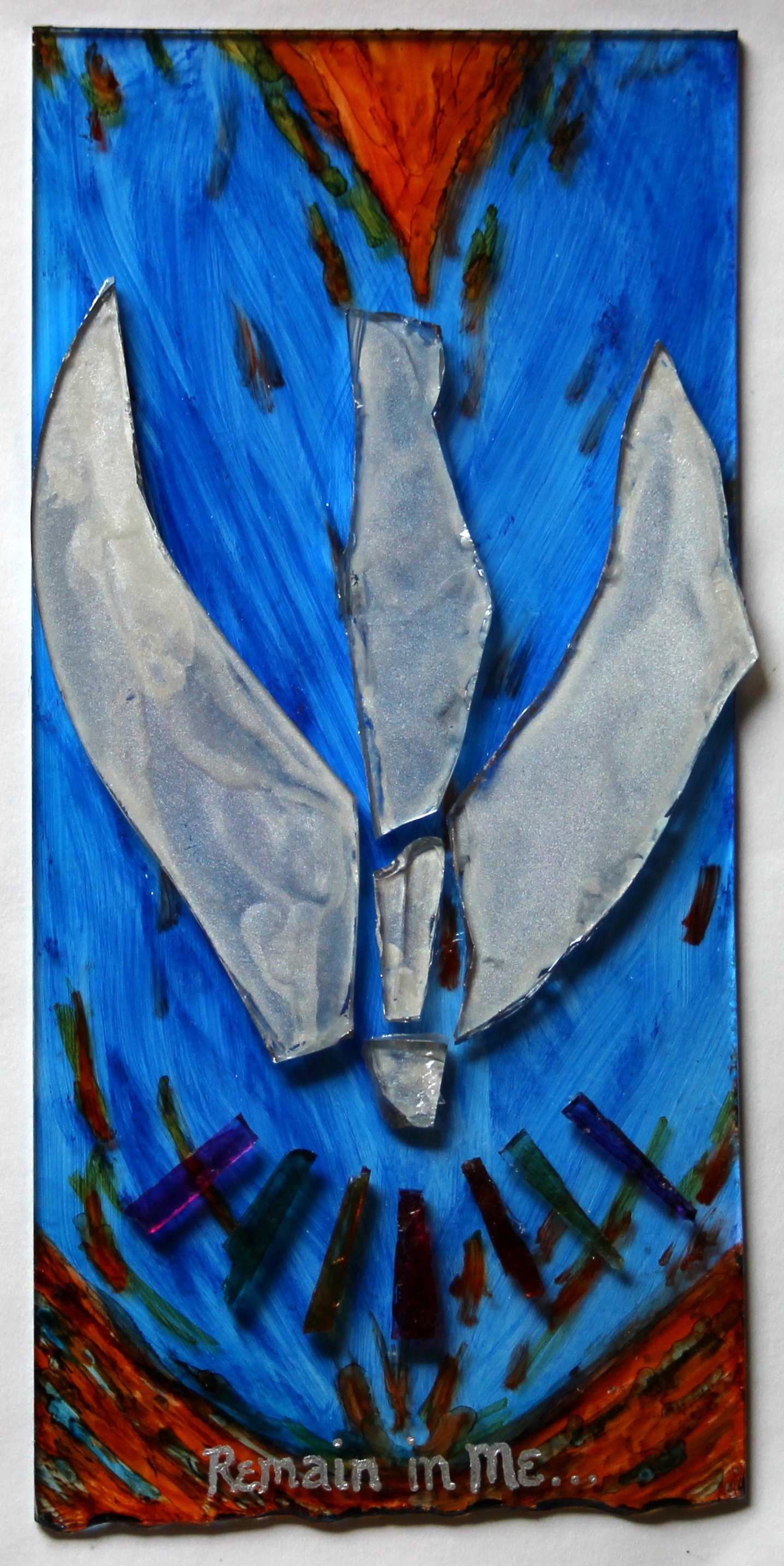
The other gift is a glass sculpture I was allowed to fashion depicting the Spirit as a dove descending, along with Christ’s words “Remain in me”. As with the Cross posted at the onset of Lent, bits of broken glass salvaged from my broken window came together to form the image.

IMG_0120

May we remain in Him always, by the power, grace and comfort of His Spirit, to the glory of our Father in Heaven. Amen.

+++

Addendum. Texts for the recordings:

From a catechetical instruction by St. Cyril of Jerusalem, bishop.

(Cat.16, De Spiritu Sancto 1, 11-12. 16: PG 33, 931-935)

The water that I shall give him will become in him a fountain of living water, welling up into eternal life. This is a new kind of water, a living, leaping water, welling up for those who are worthy. But why did Christ call the grace of the Spirit water? Because all things are dependent on water; plants and animals have their origin in water. Water comes down from heaven as rain, and although it is always the same in itself, it produces many different effects, one in the palm tree, another in the vine, and so on throughout the whole of creation. It does not come down, now as one thing, now as another, but while remaining essentially the same, it adapts itself to the needs of every creature that receives it.

In the same way the Holy Spirit, whose nature is always the same, simple and indivisible, apportions grace to each man as he wills. Like a dry tree which puts forth shoots when watered, the soul bears the fruit of holiness when repentance has made it worthy of receiving the Holy Spirit. Although the Spirit never changes, the effects of his action, by the will of God and in the name of Christ, are both many and marvelous. The Spirit makes one man a teacher of divine truth, inspires another to prophesy, gives another the power of casting out devils, enables another to interpret holy Scripture. The Spirit strengthens one man’s self-control, shows another how to help the poor, teaches another to fast and lead a life of asceticism, makes another oblivious to the needs of the body, trains another for martyrdom. His action is different in different people, but the Spirit himself is always the same. In each person, Scripture says, the Spirit reveals his presence in a particular way for the common good.

The Spirit comes gently and makes himself known by his fragrance. He is not felt as a burden, for he is light, very light. Rays of light and knowledge stream before him as he approaches. The Spirit comes with the tenderness of a true friend and protector to save, to heal, to teach, to counsel, to strengthen, to console. The Spirit comes to enlighten the mind first of the one who receives him, and then, through him, the minds of others as well.

As light strikes the eyes of a man who comes out of darkness into the sunshine and enables him to see clearly things he could not discern before, so light floods the soul of the man counted worthy of receiving the Holy Spirit and enables him to see things beyond the range of human vision, things hitherto undreamed of.

+++

From the treatise On the Holy Spirit by St. Basil the Great, bishop

(Cap. 9, 22-23; PG 32, 107-110)

The titles given to the Holy Spirit must surely stir the soul of anyone who hears them, and make him realize that they speak of nothing less than the supreme Being. Is he not called the Spirit of God, the Spirit of truth who proceeds from the Father, the steadfast Spirit, the guiding Spirit? But his principal and most personal title is the Holy Spirit.

To the Spirit all creatures turn in their need for sanctification; all living things seek him according to their ability. His breath empowers each to achieve its own natural end.

The Spirit is the source of holiness, a spiritual light, and he offers his own light to every mind to help it in its search for truth. By nature the Spirit is beyond the reach of our mind, but we can know him by his goodness. The power of the Spirit fills the whole universe, but he gives himself only to those who are worthy, acting in each according to the measure of his faith.

Simple in himself, the Spirit is manifold in his mighty works. The whole of his being is present to each individual; the whole of his being is present everywhere. Though shared in by many, he remains unchanged; his self giving is no loss to himself. Like the sunshine, which permeates all the atmosphere, spreading over land and sea, and yet is enjoyed by each person as though it were for him alone, so the Spirit pours forth his grace in full measure, sufficient for all, and yet is present as though exclusively to everyone who can receive him. To all creatures that share in him he gives a delight limited only by their own nature, not by his ability to give.

The Spirit raises our hearts to heaven, guides the steps of the weak, and brings to perfection those who are making progress. He enlightens those who have been cleansed from every stain of sin and makes them spiritual by communion with himself.

As clear, transparent substances become very bright when sunlight falls on them and shine with a new radiance, so also souls in whom the Spirit dwells, and who are enlightened by the Spirit, become spiritual themselves and a source of grace for others.

From the Spirit comes foreknowledge of the future, understanding of the mysteries of faith, insight into the hidden meaning of Scripture, and other special gifts. Through the Spirit we become citizens of heaven, we enter into eternal happiness, and abide in God. Through the Spirit we acquire a likeness to God; indeed, we attain what is beyond our most sublime aspirations—we become God.

He ascended…

This is essentially a re-blog except that I am adding my audio recording of this beautiful text. I often find that I like to listen and so I offer you that opportunity as we together reflect on the Ascension of the Lord.

Many thanks to Mark Armitage at enlargingtheheart.wordpress.com for seeking out and sharing this passage (and so many others).


(second version of recording – see comments)


(text, for those who wish to read)

1

Abandoning on earth the things of earth,
Leaving to the dust the things of ash,
Come, let us come to our senses and let us raise on high our eyes and minds.
Mortals, let us make our sight together with our senses
Fly to heaven’s gates.
Let us imagine we are standing on the mount of Olives
And that we bend our gaze on the Redeemer
As he rides upon a cloud.
For from where the Lord has hastened back to heaven
There too the One who loves to give has distributed his gifts
To his Apostles, cherishing them as a father and crying out to them,
‘I am not parting from you. I am with you and there is no one against you.’

2

The One who came down to earth, as he alone knows how,
As he ascended from it, again as he knows how,
Took those he loved and led those he had gathered to a high mountain,
That, having mind and senses aimed on high,
They might then abandon all that seeks the ground.
And so, having climbed the hill of Olives,
They surrounded the Benefactor,
As Luke, the initiate, recounts,
While the Lord, raising his hands like wings,
Sheltered them, as an eagle the nest which it was warming,
And says to the nestlings, ‘I have sheltered you from all evils.
As I have cherished you, do you love me.
‘I am not parting from you. I am with you and there is no one against you.’

3

High over you, my Disciples,
As God and Maker of the whole world
I stretch out my palms, which the lawless stretched out, bound and nailed.
And so, as you bow your heads beneath my hands,
Understand, know, my friends, what I command.
For as though baptising I lay my hands upon you now,
And having blessed you send you out
Enlightened, and made wise.
Upon your heads praise and majesty,
Upon your souls illumination, as it is written,
For I shall pour out upon you of my Spirit, and you will accepted by me,
Taught and chosen, faithful and my own.
‘I am not parting from you. I am with you and there is no one against you.’

Romanos the Melodist (c.490-c.556): Kontakion on the Assumption, 1-3, trans. Archimandrite Ephrem Lash @ Anastasis.


The well

(I offer you this little poem…it is recorded if you prefer to listen, and is followed by the text, should you prefer to read.)


the well is deep
but it did not come into being
+++without pain.
they came to dig one day
in that field i bought
+++just last year –
the one that cost me everything
+++i owned.

“why here?” i wondered,
as i signed the permit
they thrust before me.
“why dig a well here,
+++in this field,
in my field, that is so
full of rocks and weeds?”

yet they began,
+++digging,
++++++drilling,
+++++++++boring,
breaking through old roots,
crushing layers of stone,
deeper and deeper
+++into the heart
where the treasure lay.

as much as i knew it would happen,
it still stunned me to see
what bubbled to the surface,
+++so clean and pure and holy.
come. come – drink of the joy –
+++it is free.
++++++it is all for you.

++++++ +++

The adventure (and what came next)…

I set the box on the counter, paid the clerk and exited the post office as though it were any other transaction. Once in my car, however, my heart felt unbearably heavy and my eyes welled up with tears.

“Good-bye, little camera,” I whispered into the emptiness. “I’m so sorry.”

(One week earlier…)

The new one had been so excited about the adventure (see past post, New beginnings) that she hardly minded the long day of being jostled about and stuffed under seats in her camera bag. Her camera bag, she thought with contentment. She realized that the bag had once belonged to the old camera but she no longer felt threatened by her predecessor. She understood now. Her person was grieving for her old friend but welcomed and accepted her without reservation.

It was dark when the last of the three airplanes they had boarded that day landed in the tiny airport in central California. The new one listened with interest as her person greeted her old friend, Rodger, whom she hadn’t seen in decades. She could not see anything from within the camera bag, of course, but she was intrigued and anxious to view the outside world that awaited her. Things were different here. She could feel it in the air.

The next morning was bright and sunny. Accompanied by Rodger, the new one and her person emerged into cool morning air and were immediately greeted by a collage of colors and shapes, light and shadows. Click! Click! The new one began playing and exploring with a studied excitement.

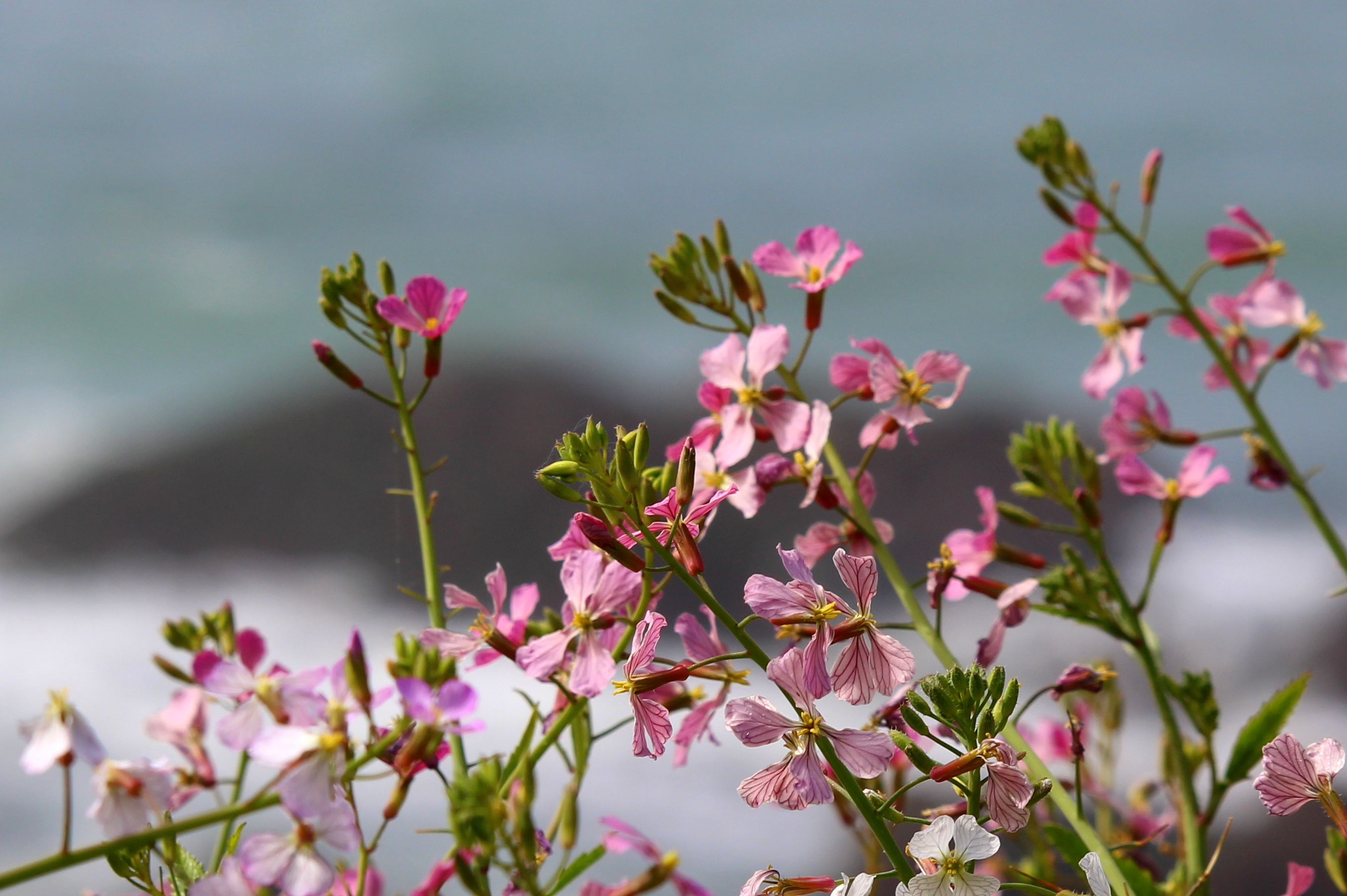
With her zoom lens on, she could see the ocean waves at the end of the street. Yet along the way, there were so many flowers! She didn’t know what to do first – it was all so very beautiful. Click!

IMG_0015

As much as she wanted to pause and absorb the colorful blooms, the ocean drew her inexorably. The flowers would wait. She and her person had to see the ocean.

Although she had imagined this moment many times while waiting in the dark, the new one was utterly unprepared for what awaited them at the end of the road. In a vast expanse of blue, the sky and the sea seemed to kiss lightly at the horizon, while crashing waves belied the true power of ocean as it beat itself against the rocky shoreline.

IMG_0024

Click! Click! Click! In quick succession, the new one received images of waves, crashing and splashing resplendently. To her delight, she also discovered a thick carpet of flowers at their feet and a variety of seabirds soaring overhead. Click! Click!
IMG_0085

IMG_0122Massive rock structures rivaled the sea in their breathtaking beauty, while each moment seemed to bring new angles of light and shadow.

IMG_0124

The sea turned from blue to green to gray and back again, sharp lines blurring into hazy fog that soon blew their way back into focus. The new one framed and focused and clicked to her heart’s content.
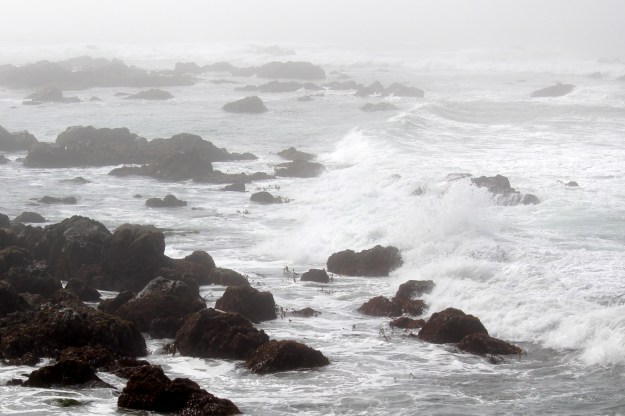
IMG_0117

The day was still very young and the new one could not have imagined being happier. She felt so alive, so joyful, as the three of them walked through fields of flowers while never losing sight of the glorious dome of sky and basin of roaring sea.

IMG_0096

IMG_0101

IMG_0103

Next it was time to explore the smaller inhabitants of this vast and seemingly endless world. After her person and Rodger had climbed down to a somewhat lower vantage point, the new one began zooming in on the tiny creatures dwelling in the little tide pools formed here and there among the rocks. A hermit crab. Click! A sea anemone. Click!

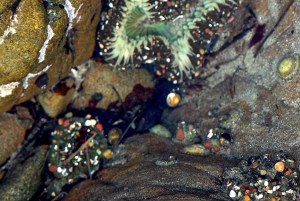
IMG_0129

IMG_0131

The colors and textures fascinated her and there was so much to see. She wanted to study each and every detail closely…

IMG_0132

(the final image)

Suddenly, from the secure spot where she was strapped around her person’s neck, the new one felt something very odd. Her person’s feet were stepping strangely out of control. What was happening?

There was a splash. Cold water quickly invaded all the new one’s hidden places, the sting of salt burning her most sensitive surfaces in seconds. With that, she knew no more.

The new one had received a life total of only 132 images when she died on that very first day of her great adventure.

+++

It was a glorious morning. I had not seen my spiritual brother, Rodger, in over 30 years and yet it felt so natural to follow his lead as he took the new one and me from one breathtaking beauty to the next.

Never having been to the coast before, my soul felt as though it had entered a living cathedral where everything gave glory to God together in a perfect synchrony of movement and color. I couldn’t stop smiling.

The vastness of the sky and sea seemed to call me to enlarge my heart so I could absorb its God-ness. Yet, amateur photographer that I am, I have always had a special love for closer looks at the tiny, hidden creatures of nature that a only a camera lens can provide.

Hence, when Rodger led us to the tide pools, I welcomed the shift to a smaller world. After some introductions to the different species, we each wandered in different directions and the new one and I received some images. The air was still cool but the sun was shining warm. What could be more delightful?

What happened next is hard to explain. The new one and I were gazing at some interesting plant growth when it seemed as though my feet started to move. I cannot say how or why. I found one foot moving to a large stone in front of me but I could not stop it. The other foot moved reflexively to the next stone to try to gain footing but I still could not stop.

And the next thing I knew, I was suddenly immersed cold salt water – just deep enough to drench everything but my head. Stunned, I immediately stood up, dripping and heavy from all of the sea my clothes and shoes could absorb in those few seconds.

I looked down at the new one, still hanging faithfully from her strap around my neck. A yellow light I had never seen before was blinking. Knowing this could not be good, I turned her power switch to the “off” position and accepted the extra sweatshirt that a concerned Rodger was now offering.

Strangely, I still couldn’t stop smiling. It seemed as though I should be upset but I wasn’t. I was chilly. Wet. Definitely wet. But I was very much in the moment I was in and nowhere else. I was still in the living cathedral and nothing else really mattered.

There was a vague sadness about what had happened to the new one. But it was simply something that had happened and could not be undone. It was just reality. And so I moved forward, placing one squishy foot in front of the other, my faithful brother at my side.

When I emerged from the warm shower in dry clothes, I was greeted by a cup of warm ginger tea. Judy, Rodger’s wife, was on the phone with Canon, trying to determine what, if anything we could do for the new one.

When it was evident that I would need to mail my drowned friend back to her maker, Judy immediately offered to lend me one of her digital cameras for the remainder of my stay. I would buy a memory card to hold the images so that I could take them home with me.

I had only met Judy for the first time the night before. In that moment, I knew she was my sister.

+++

It did not take long to realize that what I had lightly written of as an “adventure” was so much more. Literally hundreds of images were received. Many cups of ginger tea were drunk. Meals were eaten, naps were taken, books read. Prayers were prayed and thoughts were shared on into the evening.

Oh – and did I mention two very unique and wonderful teenage boys?

But throughout this time, I continued to feel as though I remained in that living cathedral, though at the time I would not have had a name for it. Whether I was indoors or out, alone or with one or all of the others, there was a sense of being in a sacred place.

At one point, Rodger and I talked some about the idea of pilgrimage. He felt some interest stirring in such an undertaking. As I pondered this, I realized that this trip across the country to see him and his family was, for me, a pilgrimage.

We often think of pilgrimage as a journey to a particular holy placeperhaps a place were many people have experienced God’s love in miraculous healing (such as Lourdes, in the Catholic tradition) or where many holy people live together as vessels of God’s grace (such as Mt. Athos, in the Orthodox tradition).

While that is indeed a true meaning, it is true not because one geographical place can claim God’s presence more than another, but because the journey itself disposes our hearts to meet God more deeply.

We take on the journey because we know we need God. We may simultaneously want other things, such as to see a friend or to have a break from work, but what we need is God Himself and nothing more.

When we say to God “I need you” so deeply that we stop everything else in our lives and make a journey for Him, He gives Himself in great abundance. It may not always be what we expect – but He does not ignore our longing.

This was indeed a sacred journey. I cannot express in words all of the dimensions of the holiness that I experienced. But I can say that I came away changed by my encounter with God – God in the ocean and the sky, in the seals and otters, in the flowers, birds, reptiles and butterflies.

…and most of all, God in those whose hearts long for Him through the same moments of light and shadow as mine.

To Him be eternal praise and glory.

 +++


(The following video invites you to join in some of the wonders God shared with me during this pilgrimage. Be sure to watch in full screen!)
 

Pilgrimage from Mary Benton on Vimeo.

The new Life

They arrested the apostles and put them in the public jail. But during the night an angel of the Lord opened the doors of the jail and brought them out. “Go, stand in the temple courts,” he said, “and tell the people all about this new life.”                                                                                                                    (Acts 5: 18-20, NIV)

+++

Once again, I begin writing on a topic about which I feel unworthy to comment. How can I claim to know anything “this new life” (or simply, “the life”) when I myself am still living the old one?

Yet something inside of me longs to write of it.

What has changed that there is now a new life that people need to be taught?

It all seems too much for words. In my last post, I wrote of The risen Lord and the wondrous and mysterious nature of His appearances after the Resurrection. If we now read of the lives of the Apostles after the Resurrection and the outpouring of the Spirit, we find something just as wondrous and mysterious.

We read of ordinary men, weak people who doubted, questioned and shrank from the Truth much like the rest of us, acting just like Christ.

They can understand each other, even when speaking different languages. With unwavering certainty, they bring healing to people with diseases and deformities. They cast out unclean spirits – and the spirits obey them. Angels lead them out of prison, without unlocking the doors. They are undeterred by the suffering they encounter in liberating people from their sins.

It is as though these ordinary people are now living the life of the risen Christ.

And, of course, that is exactly what they were doing. The risen Christ showed them the new life, the fully Human life, the life we were created to have before we fell into sin.

Having destroyed our sin and death with His humility and love, Jesus showed them that nothing need block the way anymore to the full living of our true Human-ness. With His Spirit alive within them, His life was their life, their life was His life.

What before they would have thought impossible – or perhaps possible only for Him – they now knew was simply true. What was called a “miracle” was actually how life was made to be. It was sin that had left this unrealized, unknowable to the pre-Christian soul.

Which brings us to the disturbing question: what has become of this new Life?

I could begin a critique of the churches and say how they have failed to teach us well and so on. But the reality is that I must look at myself. Why am I not living this new Life fully? Why is my “Christian” life but the palest shadow of Christ’s, despite having been taught the faith and given of His Spirit?

I doubt very much that I am the only one asking this question.

In fact, I have read various opinions as to why there is so little spiritual healing now compared to the early Church. Some even seem to suggest that these special gifts were needed more then than they are now in order to help build up the early Church.

Yet, if we look at our world today, we can hardly deny that there is a need for spiritual gifts – miracles and grace in any and all forms.

We live in a world that is desperate for God, starving for the healing, understanding and forgiveness of sin that is the heart of the new Life. Surely God is not withholding His gifts.

Indeed, at this moment and within our lifetimes, people have been quietly living Christ’s life. Tumors have disappeared. People have understood each other without speaking the same language. Those crushed by sin, despair and addiction have found liberation through the prayers of the Spirit-filled.

It can happen. It does happen. The new Life has not died.

But I fear that if we asked most people attending Christian churches (much less the droves who have stopped attending) if they ever witnessed or experienced any of these things personally, the vast majority of them would say no.

How can this be? Again, I can only examine myself. How is it that I have lived a “Christian” life for so many years, unaware that I was not truly living the life of Christ?

I have no answer. All I can do now is live this moment in Christ.

And to live His life is not something I know how to do on my own.

Knowing my weakness, I must repent always. I must live a life of repentance – not a gloomy obsession with sin by any means – but a constant awareness of my need to turn my heart toward God. I cannot turn my heart just once. I must turn again and again, for I am so easily distracted that I lose sight of Him before I realize it has happened.

I can only hope to live the life of Christ by the gift of His Spirit. But I must do more than simply pray for His Spirit.

I must do the work of emptying myself.

God gives His Spirit to us freely – He wants us to share in His life and have the strength and comfort of the Advocate.

However, if I am full of human spirit, human preoccupations, desires and ambitions, how can I receive His Spirit?

If all of the rooms in the inn of my heart are occupied, how can I welcome this Guest? Where would I have Him stay?

Again, to empty myself does not mean to take on a gloomy, impoverished life. If the “rooms in the inn” are full of clutter or occupied by scoundrels, emptying them allows their true beauty to become apparent. Even more so as the Spirit fills them.

Any emptying, whether a fast from food or a giving up what I want for the sake of another, initially feels like a deprivation. But as the emptying creates space for Another, the joy received replaces any distress a hundredfold.

In our own small way, we become like the Apostles who rejoiced that they had been found worthy to suffer “for the sake of the Name” (Acts 5: 41). Being flogged did not humiliate or discourage them. Rather, it emptied them further that the Spirit might live more and more fully through them.

And so, weak creature that I am, I take on my life of repentance. I empty myself in my own small ways, cleaning out one by one the many rooms of my heart.

And I rejoice.

The disciples rejoiced, alleluia, alleluia.                                                                                         When they saw the risen Lord, alleluia, alleluia.  

                         – Evening prayer, Liturgy of the Hours (Catholic)

+++


The risen Lord

How could I possibly write of the Christ, risen from the dead? Surely a mystery too great for me to expound upon, as though I understood it…

Yet something beckons me to write.

There is something so beautiful, so compelling and so mysterious about the accounts of Jesus in His appearances after the Resurrection. It is this Jesus in whom the Truth comes fully alive before us – yet our minds cannot comprehend it.

He is not stopped by locked doors, yet He eats and can be touched. He is not recognized when seen but is known without doubt. He is seen by a few but also by five hundred at once. Yet not everyone sees Him. Not everyone knows.

How can all of this be? What does it all mean?

As many times as I have heard the Scriptural accounts of these encounters, something new stood out to me this year in the Gospels:

“Jesus revealed Himself again to His disciples at the sea of Tiberias.” (John 21:1)

I have emphasized the word “revealed” because that is the word to which I was drawn. Jesus did not simply appear, as a speaker makes an appearance in auditorium or as a rainbow appears in the sky. He was present and He revealed the reality of His presence to believers.

As I write this, I have to stop and struggle with it a bit. “Wait a minute,” I say to myself, “are you saying that Christ only revealed Himself to believers? Are you saying that He wasn’t there for nonbelievers to see?”

Yes and no.

Let’s stop and consider the appearance on the road to Emmaus. It seems unlikely that the two disciples who encountered the risen Lord there were the only people on the road. Jesus was well known in the region because of the recent events, as documented by the disciples’ dialogue with Him. What did the other people on the road see?

This was not recorded for us. However, I doubt very much that they saw the disciples talking to no one, i.e. carrying on conversation with an invisible or imaginary person. Yet I also doubt very much that they saw them conversing with a man who looked exactly like Jesus prior to the Resurrection.

(If they had seen either of these things, would that not have drawn a great deal of attention? The former would have caused concerns about ghosts or spirits. The latter would have drawn people to ‘come see that fellow who was crucified a few days ago – look – he’s alive!’)

Hence, what seems most plausible is that they saw the two disciples carrying on a conversation with an ordinary looking man who did not draw their attention. This seems especially probable, given the disciples’ own admission that they did not know it was Him until later.

Much has been speculated about this lack of recognition of the resurrected Jesus, most likely because it makes our logical, Western minds vaguely uneasy. If even His closest friends didn’t know it was Him right away, how can we be sure it really was Him?

This is not a minor detail. We need to know.

Yet the post-Resurrection Jesus could not have appeared looking exactly as He had before he died.

More important than the practical considerations (e.g. some would claim He hadn’t really died after all) is the meaning hidden within the Resurrection itself. If He returned appearing just the same, it would seem to suggest that He was just the same.

In other words, it would teach us that Resurrection was simply a return to the life that we already know. Returning to this life would hardly be salvation, certainly not the Kingdom of God for which we would give up our lives and everything we own.

And so the risen Lord appears. He is seen as human – or perhaps, more accurately Human, the fullness of what we were created for. Having crushed our sin and death with His humility and love, He reveals the new Life in Himself, in a new Body.

When He was recognized by His followers, it was not a recognition of the eye or the mind, but of the heart. He revealed freely and completely but not all could see that it was truly Him.

Some seemed to know Him almost immediately, others took longer. Some, like Thomas, needed quite a bit of help to believe it was true. And the risen Lord freely gave what was needed. He wanted to be known.

Yet not all recognized Him, not all knew Him. Many, perhaps, did not want to know Him – or were afraid.

It took a lot to believe – to know Him risen from the dead. And once knowing, it demanded a lot. It demanded everything.

And it still does.

Knowing the risen Lord, we can no longer live our old lives. The new Life is before us and we have so much to learn and to do.

But our Savior knows that – and He gives us all that we need.

+++