Where do I belong?

As I was driving home from work the other evening, my attention was drawn to a familiar sign bright against the darkening sky.

B-E-E-R-! It proclaimed its message by lighting up one letter at a time and then flashing the message in its entirety several times. I imagine each letter was at least as tall as I am.

While I have seen this sign innumerable times before, on this night it struck me: I don’t belong here. I don’t fit in this world, this culture that wants me to be so excited about not just beer, but drinking, partying and seeking perpetual entertainment.

Similar feelings are often triggered in me by such ordinary aspects of life as the jabbering sounds and flashing images of television or movies. Or even the many secular decorations and advertisements for “Christmas” that have nothing to do with the birth of the Lord.

I live in this world – but I do not belong to it.

Please understand that I am not criticizing anyone who enjoys the occasional beer, or who watches TV or movies or likes to decorate for Christmas.

I imagine that most serious Christians experience some reminders that we are not members of this world but rather are a people in exile from our true homeland. What reminds one person of this reality may be quite different that what reminds another.

What may feel even more troubling, however, is when we Christians run up against the experience of feeling that we do not “fit” in our own church. We may experience this for a variety of reasons.

Sometimes we experience personal injury by individuals in the church, lay or clergy. People we think of as “church” may hurt us with words or actions so inconsistent with the Gospel that we wonder how we could call this church our home.

Other times, we may experience deep disillusionment with the organization we know as “church” because of the stances it takes, actual or implied, regarding scandal within its own ranks or political matters of the world.

Sometimes suddenly, sometimes gradually, we begin to feel like strangers in our own “home”.

“Where do I belong?” becomes the cry we hear from within our hearts, as depression, anger or anxiety sweeps over us. “Am I living my faith in the wrong church? Can I remain a Christian if this is what Christians do?”

It occurs to me that, in order to address this dilemma, we need to consider two basic questions: (1) who or what is a Christian? (2) what is the Church?

While contemplating the first of these questions, I was delightfully reminded of a passage from C. S. Lewis’ Mere Christianity. Grateful to have a copy on my bookshelf, I pulled it out and searched for the appropriate passage where Lewis addresses the question of why, if Christianity is true, Christians aren’t all obviously nicer than non-Christians.

Permit me to quote a particularly relevant passage:

“The world  does not consist of 100 per cent Christians and 100 per cent non-Christians. There are people (a great many of them) who are slowly ceasing to be Christians but who still call themselves by that name: some of them are clergyman. There are other people who are slowly becoming Christians though they do not yet call themselves so. There are people who do not accept the full Christian doctrine about Christ but who are so strongly attracted by Him that they are His in a much deeper sense than they themselves understand. There are people in other religions who are being led by God’s secret influence to concentrate on those parts of their religion which are in agreement with Christianity, and who thus belong to Christ without knowing it.”

He continues on to say that it is easier to compare dogs and cats because at least we know definitely which is which. Dogs don’t suddenly (or gradually) turn into cats or vice versa. Lewis makes many other fine points about the dilemma he is addressing but I will resist the temptation to deviate from our own question.

Bearing this in mind, we recognize that while we can know what a Christian is, we can never know the who, i.e. we can never know with any certainty if any given individual is a Christian. Simply because one is a bishop or a priest, for example, does not guarantee me that they are Christians. And the reverse is true as well: when someone appears to be on the outside, I have no way of knowing whether they actually belong to Christ.

In his extended explanation, Lewis makes another point well worth noting: that we cannot judge by any individual’s negative actions or temperament whether or not they are a Christian. Someone may have their life under the proper “management”, having given over their wills to Christ, but still be engaged in the struggle to repent and overcome their negative beliefs and behaviors.

This makes it apparent that we cannot judge who is a Christian and who is not. And we know, from our Gospel, that it is not our business to judge others anyway but to work on ourselves.

This becomes relevant to our discussion because, whenever we are hurt or disillusioned by individuals (or even subgroups) within the Church, we may be suffering at the hands of people who are either not really Christians (and thus not representing the faith) or individuals who, like us, are still sick and struggling to accept the cure.

Thus, I would suggest that finding such people and behaviors within the Church is no reason to reject either the Church or Christianity. It is simply a reality that accompanies the gift of our free will. God offers His grace to draw all people to Himself – but He does not force it.

To not feel “at home” with other sinners is a case of our pride allowing us to forget that we are as lost as all the rest. If we have been given the grace to see things more clearly than another, we must both give thanks for this unmerited gift and pray that others find their way into such grace as well.

Now, to our second question: what is the Church?

As I have written elsewhere (see “About blog” tab), when I am referring to the Church, I am talking about the Body of Christ here on earth, the community of the faithful. These faithful may be Orthodox or Roman Catholic, Pentecostal or Anglican, or quite possibly, not participating in any organized religion at all.

There is only one Church and it is not about “religion”. Rather it is about the New Life given us by Christ our Savior when He died and rose from the dead. This “Church” that He gave us was never intended to become just another religion (splintered into other “religions” because of human disagreement). In giving us this Church, He has given us the Kingdom of God.

The objections or confusion I often receive at this point typically go something like this, “Well, that’s all fine and good in the abstract. But…” After the “but” may be a listing of all that is different between one human ecclesiastical institution (“church”) and another, with arguments about how certain beliefs or practices of one are more true than the others. We cannot be one Church.

Or, just as well, the “but” may be followed by a listing of the most particularly egregious behaviors of individuals who lead our human institutions – of particular priests, pastors or bishops – or even patriarchs and popes. What they have said and done cannot constitute “the Kingdom of God”.

And there is some truth here. Our sins most certainly do not constitute the Kingdom of God – and our membership and leaders are still quite capable of sin, even delusion.

But none of that undoes what Christ did and what He gave us. And all have been made part of the Body of Christ on earth – unless we choose to leave It. He did not die and rise for just some of us, but for all of us.

Christ can only have one Body. And He brings into it all who accept His invitation – every one a sinner who seeks the Cure.

This may seem odd to us. How can Christ have such an imperfect Body – one made up solely of sinners, most of whom are still sinning?

This can be only because, in His love, He brings in all of the imperfect so that can we be made perfect in Him. And so He draws us in, if we allow it, and He bears the wounds of our sinfulness until the final Resurrection.

If ever we should think, “Perhaps I should leave the Church. I cannot bear that this person or this group in the Church has done this”, shivers should run up and down our spines. Shivers of fear and dread that we would ever think of cutting ourselves off in such a way from our only hope of Life.

Let us return briefly to hear what C. S. Lewis wrote about this, when discussing our concerns for those outside of the Body:

“Christians are Christ’s body, the organism through which He works. Every addition to that body enables Him to do more. If you want to help those outside you must add your own little cell to the body of Christ who alone can help them. Cutting off a man’s fingers would be an odd way of getting him to do more work.”

So not only for ourselves must we never leave but for those on the “outside”. And, given the discussion above, we need also remember that some who appear to be on the inside may actually have gone outside.

To see ourselves as a Body is also essential to Christian identity. Belonging to the Church is not at all like being in a social club or a political movement, where I may well choose to leave if I find myself in disagreement.

Lewis’ use of the word “organism” lead us to a deeper contemplation of this reality. My foot does not leave my body because it doesn’t like what my hands are doing. We are all part of each other in the Body. Our collective sinfulness would, of course, be terrifying were Christ not head of the Body. His Headship assures us that we will, in the end, be safe.

Still further concern may be raised. “I wasn’t thinking of leaving the Body. I just want to change to another church, one where…” (After the word “where” hopes are voiced for a better priest, a better ecclesiastical public profile and so on.)

There are indeed times when, with careful prayer and discernment, one needs to make such a move. This is particularly the case when one finds oneself in a denomination that promotes heretical beliefs or leaves one starving for the Sacraments.

However, I suspect that such moves are not needed nearly as often as we may think. If in the Body I am currently in the foot, I may imagine that things will be much better should I move to the hand. But, until the time of fulfillment, the reality is that I will find sinners there as well.

In every part of the Body we find sinners struggling – or not struggling and becoming less and less Christian whether they know it or not. However, in every part of the Body we also find saints who inspire and nurture us in the faith.

We are not made perfect by a change of scenery, even if the current scenery is very much undesirable. Our Cure lies in being in the Body of Christ and learning to see Him and know Him in every “self” we encounter.

The Lord Jesus was not speaking in metaphor when He commanded us to love our enemies. Hence, whenever we encounter someone in the Body – or even an entire organ of the Body – that appears diseased, it is our duty to pray for their healing.

Indeed, we are to make ourselves available should Christ desire to make us the vehicle for their cure. Would we not want the same for ourselves, if knowingly or unknowingly we came to be at odds with the Gospel?

To love our neighbor as ourselves, as Lewis points out, is to want for every other self what I want for my self.

If I may, I will wrap up the article with a bit of my own story. As many of you know, I first stumbled upon Christian Orthodoxy via a Google search that landed me at Fr. Stephen’s blog (glory2Godforallthings).

After about two years of very active reading and commenting on this blog, as well as reading other helpful texts, I felt so close to the Orthodox and their spirituality that I began to wonder if I was meant to become Orthodox.

What happened next was very strange. I cannot adequately describe it but will assure you that I did not see visions or anything of that sort.

First, I went through an experience that I have likened to St. Paul being knocked off his horse (though I realize that he probably wasn’t actually on his horse when confronted by Christ). I felt a sense of confusion and unreality. Suddenly I knew, as though I had been divinely ordered, that I was to fast from Fr. Stephen’s blog.

There was no suggestion that there was anything at all wrong with his blog. It was more about what was happening within me.

At first, I thought perhaps I was just being silenced from commenting, as I had been commenting a great deal. But no, if I even tried to go there just to read, I felt the message within, “you are not to be here”. And so I obeyed.

Although I no longer remember the sequence of events exactly, during this same time period I recalled some of the newly converted Orthodox who commented on the blog indicating that they had finally found their home. Some of them felt it the moment they walked into an Orthodox church.

It was then that another message came to me, “You already have a home”. Again, no visions or voices, just an inner message that I discovered within me. Further, it was given to me to realize that I had been sent to study with the Orthodox but not so that I could stay there.

Eventually, I was “allowed” to return to Fr. Stephen’s – which I do now fairly frequently – but with a different mindset. I recognize there members of the Body. I know that we are one Church and that Christ can make use of any of us to help each other along the way.

And so He has, time and time again. I am so grateful.

My home is with Him, in His Body – and He is teaching me the love that makes us all One.

To Him be glory forever. Amen.

+++

(All references in this article to the ideas of C.S. Lewis were derived from his book, Mere Christianity.)

Living in Poverty

It began last Friday with a scratchy sore throat.

Certainly a sensation I’ve had before, though not in a quite some time. Never a welcome experience.

Predictably, it followed its course: sneezing, stuffy nose giving way to the Great Run and back to stuffy. So cold – extra layers of clothing, blanket, space heater, tea – still so cold. Muscles and joints aching.

Efforts to sleep interrupted with odd thoughts and dreams. Or nose-blowing and coughs. So tired.

Feeling unable to do anything but bored doing nothing. Then sleeping uncontrollably during the day, this “luxury” permitted, having stayed home from work.

Not wanting to eat, gut rumbling. Should eat something. I must have something besides lentils here…

Yes, indeed, I have a cold.

Such a common malady – why bother to write of it? Certainly not for sympathy. Everyone gets them and many have far more serious conditions to bear.

I write because I am reminded by this experience of just how very impoverished I am. Almost all that I had planned to do over the weekend had to be set aside. Not only were my capabilities diminished but I did not want to spread the virus.

Things pile up when I am not well. Stacks of newspaper and other recyclables wait to be taken outside. My dining room table remains cluttered with the junk mail that I had promised myself I would go through. Things needed from the store – well, those have to wait.

A wise priest recently preached at a funeral service how we tend to believe that our lives are our own. But they are not. Life is given to us and life can be taken from us at any time by God. We, as believers, know that there is more to this story – but it is still our reality.

We are not in charge. We are poor.

I am not in charge. And to know that even my life is not my own is a condition of utter poverty.

I am not, of course, writing of the material poverty that many throughout the world suffer – nor am I minimizing how horrendous that is. Rather, that poverty is an outward manifestation, a visible expression of the deep poverty that afflicts us all.

When we have enough things (food, shelter, entertainments, etc.), we can live as though we are in charge and convince ourselves, at least for the time being, that we are not poor.

And it is perhaps this belief that enables us at times to believe that what we have is ours – we’ve earned it and therefore have a right to protect it from those whose need might encroach upon it. Whether it be our land, our jobs, our food or our medical resources, it is ours.

Let those others earn it, like we had to. It’s not our fault if their country is unstable. Their mental or physical problems are not our concern. We cannot go about rescuing everyone who has a problem.

We’ve made our choices and they’ve made theirs.

Or so it seems.

So it seems until God intervenes and reminds us that we are all poor. In just a moment’s time, I might discover that all the control I thought I had was never mine to begin with.

An illness. An accident. An unfair job loss.

Suddenly, unexpectedly, we too are among the poor. And we discover it was not a choice.

This poverty extends beyond the material things we believe are ours to all other domains of our lives.

It takes only the common cold to show me that I am not in charge mentally or spiritually either.

I always hate to cancel my patients’ appointments. I know people schedule them because they need them and that it can often disappoint or upset them to have to wait longer. I struggle with this but I cannot work if I cannot do so competently.

This morning, my mind was in a great fog and I knew I could not perform my job. As I attempted to notify my patients, everyone was gracious – but one dear woman was finding it difficult and needed to tell me what had been happening in her life anyway.

As she spoke, I struggled to make sense of her words. She was speaking standard English but my brain was having trouble interpreting it. Fortunately, she seemed to get some relief from the telling and I tried to sound sympathetic. I think I got the gist of it and the rest will wait a few days.

But my brain was not my own. It wasn’t working the way I wanted it to. My poverty was evident.

Yesterday, I wanted so much to participate in Liturgy despite this virus and so I attended a church nearby where I knew I could find an isolated spot. I did not want to spew my germs upon unsuspecting bystanders.

The words of the priest and Scripture droned on and I waited for them to be over. I knew they were good words but I could not feel their goodness. I knew that communion is and was the most wonderful experience I could hope for – but I could feel none of it.

In my poverty, even my spiritual life was barely my own. All I had left was The Choice.

The Choice? What is this?

In the poverty of my being, God teaches me that nothing that I believe to me mine is truly mine. All that I have and am are gifts from Him – that He may take back or suspend at any time to serve His glory.  (And how it serves His glory is completely incomprehensible to me.)

But The Choice is the one thing He does not take back.

The Choice is my will, my option of how I respond in whatever circumstances I am in – material wealth or hardship, good health or desperate illness, spiritual joy or aridity.

It may appear at times as though He has taken it back, especially when bodies or minds fail us.

But The Choice is something so fundamental to our being that it does not die with our brain cells. It is deep in our souls.

And He never takes it from us because He wants to always leave us the freedom to give it to Him – to give Him our wills, our entire selves. This Choice is one that only we can make. And we can make it when it seems that there is nothing else left, when we feel nothing and nothing seems to matter.

We can always still choose Him.

And so, I choose Him.

I choose Him knowing that I am utterly poor and destitute.

I choose Him recognizing that I have nothing to give Him but the choice itself.

And I choose Him knowing that He first chose me, loving me in my nothingness.

All glory be to Him.

+++

My King upon His throne

“You do not know what you are asking,” Jesus responded when the mother of James and John made her request of Him (Matthew 20: 22).

Most probably, the wife of Zebedee thought she was quite clear about what she wanted for her sons. After all, her two sons had left everything – most especially the family fishing business – to follow Jesus. She wanted some assurance that they were going to have a special place in His kingdom.

Like many others, this devout Jewish family likely envisioned a King who would overthrow the existing tyrannical order and establish His own rule. She probably imagined Him sitting on a throne and she wanted her sons in positions of honor and power, one on His right and one on His left.

So puzzled must they all have been when Jesus directed His attention to James and John and asked them if they were willing to drink of the cup He would drink. They, of course, did not understand yet what this meant.  But they agreed to do so.

+++

A year ago, on the feast of Christ the King, God gave me a special gift which I posted on this blog about my King.

This year, He gave me an image – an image of my King upon His throne.

Last year, I wrote, “He does not sit on a big throne of gold…”  And, indeed, He does not.

Most would not consider “it” a throne at all. Thrones, after all, are seats of dignity and honor for important people participating in important ceremonies.

Where I saw my King was none of these things.

1119161549a_burst01

                                               (image received at St. Stephen’s Church, Cleveland, Ohio)

He wears a crown but it is made of thorns. He has been stripped of His robe and His skin is torn and bleeding. He is dead.

How can I call this Cross a throne? How can I call this dead man my King?

I can only do so because my King Himself is teaching me His Way, as He taught James, John and their mother, Salome.

His Kingdom and its ways are not of this world.

The world conquers by force. He conquers by surrendering Himself completely.

The world kills to gain power. He dies to come into His power.

The world resists suffering and death – even when this results in more death. He enters suffering and death willingly, lovingly.

The world glories in domination and self. He glories in humble gift of self.

But why – why portray my King in suffering and death, enthroned upon the Cross of humiliation? Why not show Him in His glory?

The most obvious reason, of course, is that no one could possibly portray that glory. Any human attempt to do so would fail. It is more extraordinary than we can imagine – and any effort to paint or sculpt it would, unfortunately, look far too much like the glory of this world.

And we need to learn – as James and John and Salome learned – that the way to this glory is completely different. We will not learn and remember if we do not see our King in the fullness of His giving.

Our society has made it safe and easy to be “Christian” in name. Hence, we might too easily forget what it truly means to follow Him, imagining that we can just say “yes, we can drink that cup” and believe we have done so. Having died for us, He will lead us into heaven and we need do no more.

Salome, the mother of the brothers, learned the Truth. She stood at the foot of the Cross as Jesus hung dying.

James learned as well. He was beheaded for the Faith in Jerusalem. But that was not all. Such was the message of James’ words and life that the Roman soldier who led him to execution became a Christian then and there, offering himself to also be beheaded.

And John learned. John is thought to be the only one of the twelve (besides Judas Iscariot) who did not die a martyr’s death. Instead, he lived to be an old man and left us the Gospel of Love. But learn he did.

The early writer, Tertullian, tells us that this younger brother did face martyrdom, being plunged into boiling oil in the Colosseum. However, miraculously, he emerged unharmed. All in attendance saw and believed.

Our beloved King chose that one of His apostolic martyrs, one who was an eyewitness of His Transfiguration, Crucifixion and Resurrection, should survive to tell what he knew.

And so John did. But he did not just repeat the facts of the other Gospels. In fact, he left many of them out, assuming them to be already known.

Instead, John tells us that Jesus, the Word, was “in the beginning” and was with God and was God, with all things coming to be through Him. He shares with us the seven “I AM” statements of the Lord Jesus, bringing into focus His right to use the Name. And more intimately, John allows us to partake of the final words our human Jesus had with His closest friends before He died.

John leaves us no doubt about Who he knew Jesus to be. And he leaves us no doubt as to the meaning of what God did for us in Him.

In this way the love of God was revealed to us: God sent his only Son into the world so that we might have life through him.

In this is love: not that we have loved God, but that he loved us and sent his Son as expiation for our sins.

Beloved, if God so loved us, we also must love one another.

No one has ever seen God. Yet, if we love one another, God remains in us, and his love is brought to perfection in us.

                                                                  1 John 4: 9-12 (NABRE translation)

This my King.

Suffering, dying, living and loving from His throne in my heart.

Let us follow Him. Let us love as He has loved us.

Seeing in color

I wonder how many times in the course of a day I say or think to myself, “I’m going to do this,” or “I want to do that.”

It may not be exactly those words – and it may not even involve words, but it is there in my consciousness as My Plan.

One of my patrons, St. Catherine of Genoa, was given the message in the course of her spiritual journey that she was to no longer use the pronoun “I”. Whenever a plan or intent was considered, it was always, “we” – her and Christ.

Many of those whom God chooses for great holiness seem to experience something like this. It is as though they have no will, no self, apart from Christ.

Recently, I was reading from the writings of Mother Teresa (now St. Teresa of Calcutta) and learned that she had taken a private vow early in her consecrated life. Her vow was that she would never say no to Jesus.

The immensity of the suffering she endured in keeping this vow was never known during her lifetime, except to her spiritual directors.

Being chosen to live a life of holiness at this level is not at all easy or glorious. To those watching from afar, it may seem that they enjoy great favor from God – and sometimes even considerable acclaim from the world for their holiness and good works.

Little do we know about such holiness and the cross it is to the soul that bears it.

As I reflect on this, I wonder how one comes to so totally lose oneself in God. How one arrives at the point of being able to genuinely proclaim with St. Paul, “It is no longer I who live, but Christ who lives in me” (Galatians 2:20).

I certainly do not know, except that it is by grace.

And yet not by grace alone. For God does not take a man’s will from him; He does not rob a woman of her self without her voluntary surrender.

And so I am brought back to the opening lines of this post. My Plan. What I want to do. Or what I do not want.

It is a regular feature of how I relate to others and the world and God. And one that creates a great obstacle to the grace God offers me as He beckons me to become “we” with Him.

I have been abundantly aware of this in recent times. Some physical discomforts come my way – no, I don’t want those. My thoughts turn ruminative about these discomforts – no, I don’t want that. I am so tired. I don’t like that – and I don’t like my complaining about it either.

In the midst of these minor issues (yes, they are minor), it seems that God took art away from me. Whether to be like one of those sabbaticals He occasionally gives me from writing – or something permanent, I cannot know.

Throughout this time, I have found myself able to look at all of the colors in my pastel box and feel indifferent. Ideas from unfinished projects have flashed before my eyes and “Maybe another time” is all that comes forth.

As many of you know, I have loved my photography and painting rain barrels and making ink-on-glass projects. And yes, climbing onto the counter so that I could color my kitchen windows with markers.

For weeks and weeks, I have been in the desert, wondering, “Perhaps this is it.” But strangely, I knew that if it was over, it was all right.

I have been blessed with so much – and none of it belongs to me. God wants me to learn this. My body is His. My mind is His. Every little and big gift and opportunity He has given me are His to do with as He pleases.

And, if I wish to follow Him, I must surrender so completely that I accept – no, that I desire that He does with me what He pleases. And this may very well not be what, if left to my own devices, I would choose.

Following Him means doing what He did. And thus it is so: I surrender. It is the only path I can take.

I am but a beginner. I still have a great deal of will of my own. But He is teaching me and leading me.

And it is a priceless thing…

+++

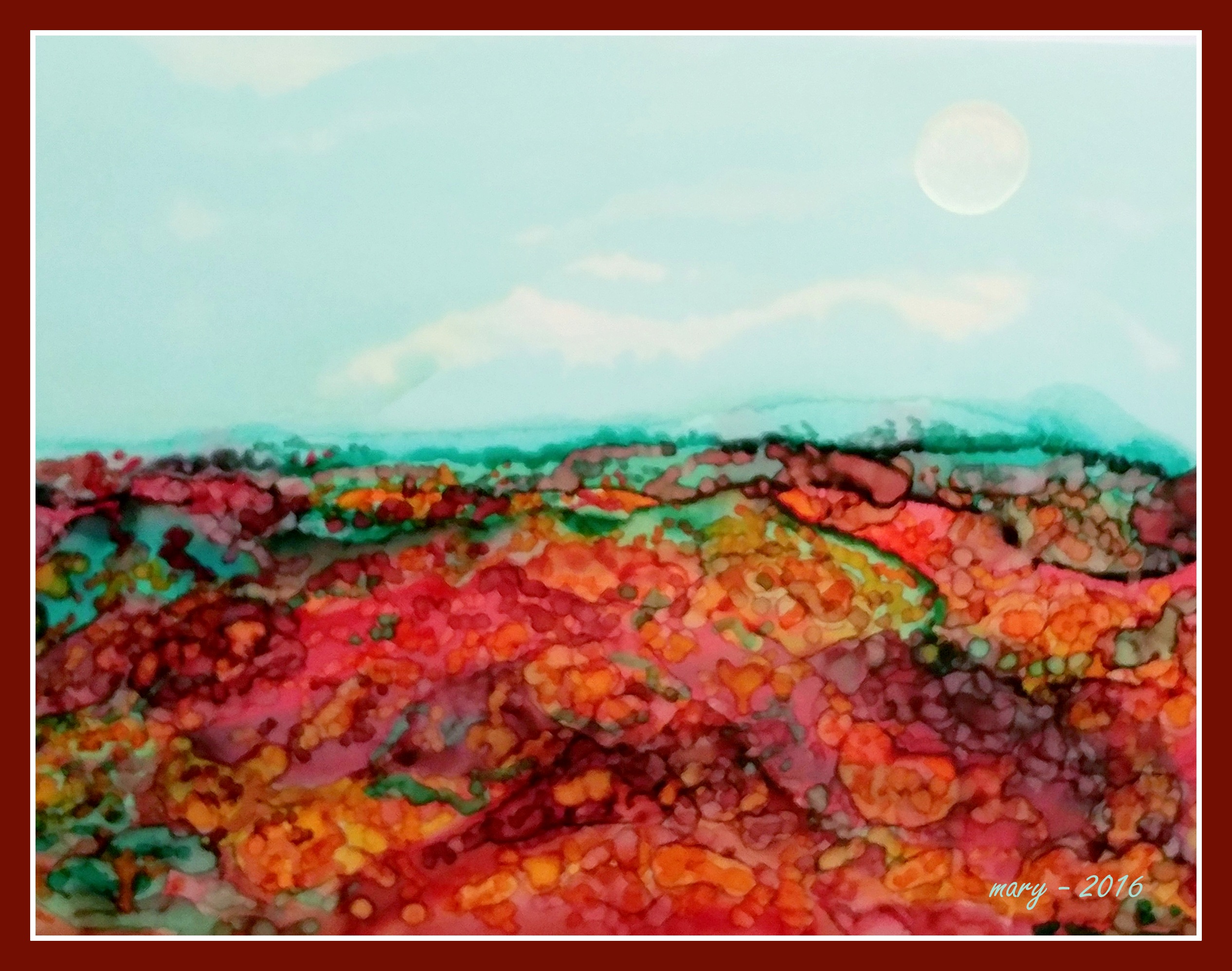
Today, quite unexpectedly, I found art in my soul again. I had dropped a bit of ink a couple of weeks ago without a lot of feeling and yesterday a poem began emerging to accompany it.

Of itself, it is nothing much – just as I am nothing much. But I share it with you to sing God’s praise. How kind and loving of Him to allow art back into my soul, even if only for a moment.

I do not know if it will be there tomorrow – and it doesn’t matter.

What matters is that I follow Him.

To Him be glory.

+++

fall-colors

+

sun drifts pale in blue

as earth bleeds red-orange joy.

life hides its shadows. 

+++

Politics and the Christian

It is a touchy thing to discuss politics with friends, even in the written word. Yet this evening, the day following a very contentious presidential election, I feel called to do so.

Some Christians I know felt there was no conscionable choice in this election. How does one vote when both candidates appear deeply flawed in their characters or policies (or both)?

Other Christians backed one candidate or the other with differing levels of enthusiasm, ranging from “the lesser of two evils” to hearty endorsement. Interwoven into these responses were perceptions, true or false, as to the extent either candidate would defend or endanger the unborn, the poor and international peace and security.

The inevitable happened.

Someone won and someone lost.

It happens every time. And, as happens most times, the outcome is viewed as disastrous by some and as an immense achievement by others.

And so it was with great consolation that I opened the Scripture readings for today and found awaiting me the following passage from St. Paul’s letter to Titus (3:1-6):

Remind your people that it is their duty to be obedient to the officials and representatives of the government; to be ready to do good at every opportunity; not to go slandering other people or picking quarrels, but to be courteous and always polite to all kinds of people. Remember, there was a time when we too were ignorant, disobedient and misled and enslaved by different passions and luxuries; we lived then in wickedness and ill-will, hating each other and hateful ourselves.

But when the kindness and love of God our Savior for mankind were revealed, it was not because He was concerned with any righteous actions we might have done ourselves; it was for no reason except His own compassion that He saved us, by means of the cleansing water of rebirth and by renewing us with the Holy Spirit which He so generously poured over us through Jesus Christ our Savior. (Jerusalem Bible trans.)

In the contemporary America, being “obedient” to the government has not been a popular concept – or even a thinkable one by most, at least since the 1960’s when everything fell apart with the Vietnam War, Watergate and the revelation that the emperor wore no clothes.

This is not to say that every citizen respected the government before that or that all disagreement was orderly. Far from it. But it seems that that time period in particular began an era in which many people became particularly disillusioned not only with government, but with such traditional notions as authority and obedience.

Were Paul’s words about the duty to obey intended only for the flock served by Titus? Or must we heed them as well?

It is a fascinating irony that I am posing this question at the same time that a very different Scripture cycle is being read in the Divine Office of the western Church. In the last couple of weeks, we have been reading from the book of Maccabees where many of God’s people were tortured and killed because they refused to abandon the Law and obey King Antiochus.

Then, just yesterday, in the Book of Daniel, we read of the three young men being thrown into the white-hot furnace because they refused to obey King Nebuchadnezzar and worship his idols.

Hence, we have an admonition to obey government while given accounts of highly esteemed followers of the Lord who disobeyed their governments unto death. What sense can we make of this?

And, of course, to add to the confusion, we must consider the enigmatic words of the Lord Jesus when such a question was posed to try to trick Him, “Then repay to Caesar what belongs to Caesar and to God what belongs to God,” He said in response. (Matthew 22:21)

These words of Jesus are our first instruction. The Latin origins of the word “obey” mean literally “to listen”. And, before all else, we know we must listen to Him. For our world is at war and He is our Commander.

And so what belongs to God? We do. We belong to a Kingdom not of this world and we always owe our first allegiance to it.

Should our government tell us to violate the laws of our God, we must obey our God first and always because we belong to Him.

But we know this is often not so easily carried out in the complex world of the 21st century. If my government uses my tax money to fund activities that violate God’s laws, how can I obey God? (As a former tax resister, I can testify that the options are few.)

Even to know what violates God’s law is not so simple to discern as we might hope. No one asks us under penalty of death to worship gold statues or to eat pork. Rather, money is withheld from our paychecks to fund so many things that we cannot understand or keep track of them all. After a time, what seemed black or white, may begin to seem so gray that we know longer know how to respond.

And it is because of this confusion on the battlefield that we must be both “obedient” and ever watchful.

In obedience, we listen. To listen, we must take time to be silent with the Lord.

We cannot listen to Him if, as St. Paul notes, we are picking quarrels, slandering or being enslaved by passions.

And is this not what we observe in modern politics? Quarrels, slander, passions?

As Christians living in the world, Paul exhorts us to remember our own enslavement – whether to these vices and passions or others. Hence, when we see others enslaved – the candidates that we do not favor, their followers, the government leaders that we think are ill-suited for duty – we are to recall that we did not become free because of our own virtue.

And so, if I have been freed of my enslavement by grace, it is now my duty to be merciful. As a “good citizen”, I am not to live like one enslaved by the passions of this world but as one who loves and respects all, especially those whom I believe to have fallen from truth or to be enslaved by passions.

I must pray for them constantly and with a sincere heart – for I too am a sinner, not saved by myself but by the undeserved grace of an infinitely compassionate God.

Yet I must also be ever watchful. For I may be confronted with decisions like the golden statues of old. When challenged by my government, who and what will I worship?

It is then that I must give myself over even more to listening in silence. For it is not my will or my passions that are to direct my behavior, but the One who redeems and directs every step of my life.

Only in silence can I hear Him. Only in stillness will He speak.

This is my obedience. This is the love I am called to.

Will you join me?

November 5th

It is November 5th and I saw a butterfly.

It is sunny today in Cleveland, Ohio, but cool. The temperature has not yet reached 60 and there is a breeze. Golden leaves are falling like rain. Could have I been mistaken, I thought, when I saw the fluttering from my kitchen window?

I pulled back the vertical blinds from the patio doors so that cell phone and I could waste no time in checking out the back yard. A squirrel scampered away as we headed out. I didn’t see anything.

So I spoke up. “Is there a butterfly out here? I’d like to see you…”

I was pretty sure it was a butterfly I had seen land in the grass and not just a leaf as leaves are not white. And sure enough, no sooner had I spoken these words when the little cabbage white took to its wings again.

I greeted it, of course, and asked if I might receive its image.

It flirted with me, however, touching on my pink cosmos bloom for just a second before flitting into the air again.

It danced around briefly and then took off in full flight, denying my request for an image. “I’ve got places to go and things to do!” its actions cried out, “You have seen me and that is enough.”

And I could hardly argue with that.

Who am I to know what tasks this little one may still have had to complete in its short lifespan? I am not a butterfly and do not know their ways.

Naturally I would like to think that it came only to deliver its message to me. But, more than likely, it had other assignments as well.

Did it have a message for me?

Well, it is November 5th.

How often do we see butterflies in Cleveland in November?

Not often, to say the least. But I saw one on this very same date two years ago. Yes, on November 5th. And I wrote about it. Do you remember? (Here is the image from November, 2014.)

11-5-butterfly

November 5th is my father’s birthday. Had he lived on, he would have been 87 today.

Is it mere coincidence that in this year when butterflies were scarce that my garden had record numbers during that week in June between my parents’ wedding anniversary and the anniversary of my father’s death?

Is it mere coincidence that, even though we have had many unseasonably warm days this fall, only today did I see a butterfly? That I happened to be looking out of my window while gathering towels for the laundry when it appeared?

Yes, it could all be coincidence. But what is coincidence, if not the coinciding of the life we see and understand with the life that is still so completely and marvelously beyond our comprehension?

In our humanness, we cannot help but look upon death with sorrow. No matter how strong our faith, it is a mystery and a parting that leaves us with a deep longing within.

But we are not left alone in our sorrow. When we keep our hearts full of love, they become able to perceive the multitude of little gifts constantly being showered upon us, reassuring us that this sorrow is but for a moment.

Everything is all right. All is most well in the eternal Love. And soon enough, we will experience this Truth in its fullness.

+++

The Weight of the Cross

This past Monday, I had cataract surgery on my right eye. My cataract wasn’t too severe but glare was becoming a problem and my glasses needed changing just months after getting a new pair. It seemed a good time to get this taken care of. Everyone I talked to remarked about how easy and painless the procedure was, so simple that I could go to work the next day.

Of course the consent form had to inform me that rare complications resulting in blindness can occur. However, most unsuccessful outcomes occurred in patients with other eye diseases.

Even though my eyes are healthy, prior to the operation, I secretly prepared myself for the worst. I prayed and entrusted my eye to God. After all, everything that I have and am belongs to Him and He may do with me whatever He wills.

When the surgery was over on Monday, the doctor told me that everything went exactly as it should. He removed the patch the next morning in his office, warning me to not expect too much. It takes time for the eye to heal and vision to clear after surgery. And so I was grateful that I could indeed see and accepted his assurances that the blurred vision, scratchiness and tearing were normal.

By Wednesday afternoon and going into Thursday, I was ready to rip out my eyeball and throw it at him.

I guess it is a good thing that God did not permit me to be challenged with blindness. Despite my valiant intentions, I never would have survived it.

This was an excellent lesson from the Lord to help me see just how very weak I am. And, in my pride, I desperately need such lessons, though I can’t say that I enjoy them.

I used to think that “pride” was limited to arrogance or conceit. If I kept myself free of those vices, I was doing all right.

How limited was my vision. How subtle is the enemy.

God, in His goodness, has enabled me to see more now – though I’m sure that there is still a great deal about which I am blind.

One of the things that I now realize is that what some people might think is my “goodness” actually has little to do with my own strength or virtue. In reality, it seems that God, discerning how weak I am, has given me an extremely light cross to carry.

Because our ultimate goal as Christians is unity with God through Christ, we recognize that this also means joining in His suffering, pouring ourselves out in love as He poured Himself out in love. Because He died on the cross, we often refer to our own sufferings and hardships as “crosses”.

In considering all of the crosses I have seen people carry in life, I would have to admit that mine weighs about 8 ounces – while others are staggering under loads of 10, 20, 50 or even 100 pounds.

The enemy attempts to lure me into a sort of self-satisfaction of thinking that I am faithful and holy – as I proudly bear my little 8 ounce cross.

Yet add a couple of ounces to the load and I begin to crumple. I’m whining and complaining within. I become irritable and distracted. One would think I was carrying a real burden.

And so, in this lesson, I am taught that I am a mere child on the path to God, carrying my tiny cross and pledging my love, while having little or no understanding of what that really entails.

I am so grateful to have been given St. Thérèse of the Child Jesus as my patron and teacher. For she teaches those of us who are very small to follow her “little way” (read more here). It is perhaps the only way for one such as me.

+++

However, there is another chapter to this story. Through an online friend, I recently learned of a family who was given one of the 100 pound crosses.

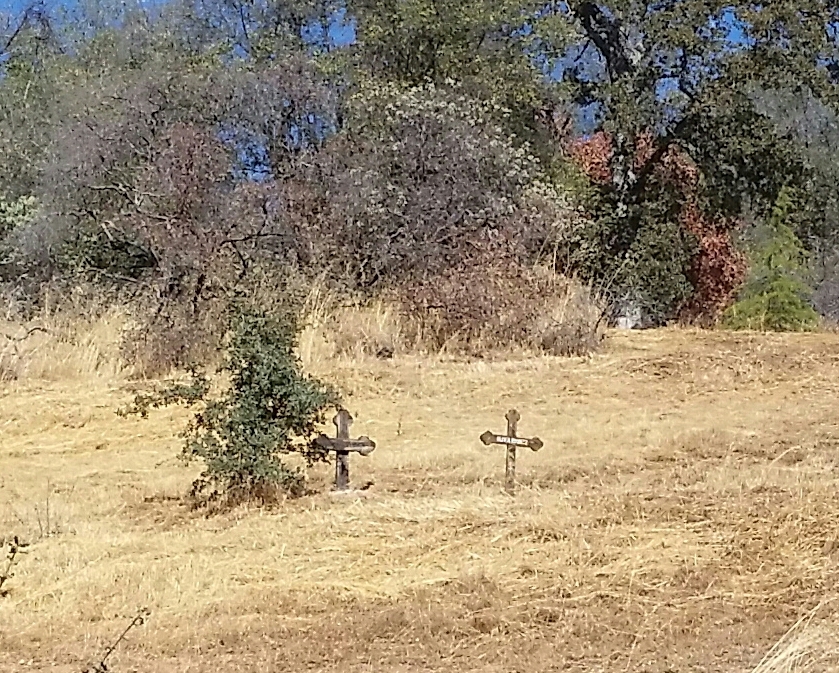
Almost two years ago, sepsis quickly took from a young couple their lovely 18 month old daughter. Her small body was buried on the grounds of an Orthodox monastery, her grave marked by a simple wooden cross. And, as any parents would, they have grieved deeply ever since.

20161009cross-later-dean

I do not know why some people are given such very heavy crosses to carry. Although I have never met this couple, I am sure that they would not consider themselves strong enough to bear it. Who could be – except with the help of Christ Himself?

Even then, I do not doubt that there must have been times – many times – when this cross seemed unbearable.

But something very interesting, very extraordinary happened recently.

A member of the faithful, a 65 year old man, departed this life for eternity. His funeral was held at the same monastery where the child was buried. The parents were in attendance and the abbess of the monastery suggested that any there might request that this faithful man carry messages to others who had fallen asleep in the Lord.

And so the father did. While acknowledging that he hadn’t known him well, he asked this man to tell his little girl to “say hi to Mom”.

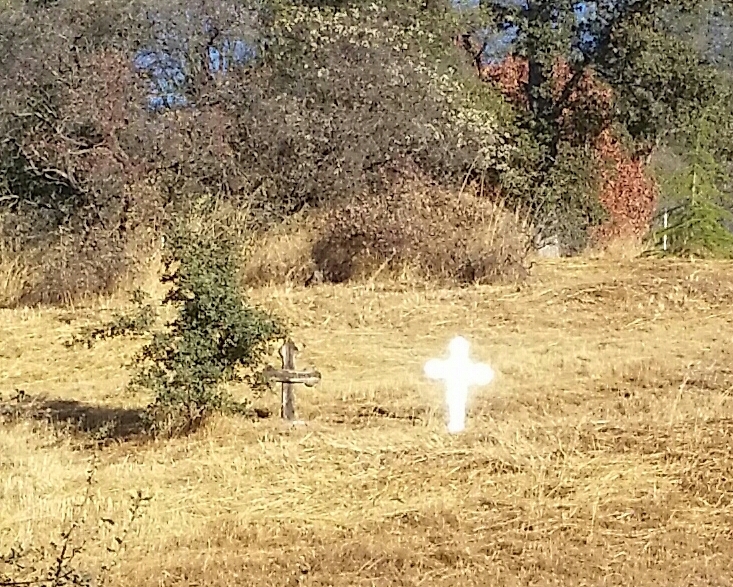
A few days later, my online friend (the father’s godfather) while looking at the cross for their recently deceased church member, saw something else glinting. Taking a closer look, he saw the child’s cross bathed in light – an exceptionally brilliant light. And he received its image so that he could share it…

20161009-cross-light-dean

+++

What does all of this mean?

For the parents to see this image must have been a great consolation, though undoubtedly a highly emotional one.

How else could they (or we) interpret it but as an assurance that their loving message was received and that their daughter is indeed enjoying the fullness of light and joy in heaven?

While it does not bring their daughter back to them, it may make the unbearable a bit more bearable as the “things unseen” that they know by faith are, for a moment, made visible to their aching hearts.

But I think that there is an additional message in this image for all of us.

I wonder why God chose the child’s cross to carry the message of consolation. Certainly there were an infinite number of ways He could have accomplished this.

Of course, it marked her grave and thus would seem a logical choice.

But also, it is a cross.

At the time we carry them, all of our crosses feel heavy to us, whether they weigh 5 pounds or 100 (or just 8 ounces). We feel overwhelmed and discouraged and alone with them.

We cry out to God, as did the Lord Jesus when He hung from His, and we feel lost in unending darkness.

And yet, here – here – it seems that God lifted the veil for a moment. For just a moment in time, He has given us a glimpse of what lies on the other side of the crosses we carry.

“Come, see what I have done. I have gathered to Myself all of your pain, your anguish, your tears and sleepless nights. I have taken your cross and drawn it into Mine, and the darkness is no longer dark but light, My light – My glorious and eternal Light. Come, My love. Do not be afraid. Do not be afraid…My joy awaits you.”

It is this cross, this cross of light that I will keep ever before me as I stumble through the darkness.

God is with us. Yes, He is with us always.

+++

(Many thanks to my online friend, the parents of the child and the abbess of the monastery for permission to use here their story and photographic images for the greater glory of God.)

The sluggish prayer life

We Christians are often unhappy with our prayer lives – or so it seems. I hear this from friends, read it on blogs and have certainly felt it myself.

We seldom feel like we are doing prayer “right” and we may even feel that God is as dissatisfied as we are. We cannot help but recall Jesus’ expression of disappointment with His closest friends in the garden, “So you could not keep watch with me for one hour?” (Matthew 26: 40).

What does it mean to have a sluggish prayer life? Why does this happen to us and what can we do about it?

I must admit this topic came to me in a rather humorous way. I recently returned from a weekend stay at the hermitage I frequent – where my spiritual life was anything but sluggish.

While there, God both challenged me and showered me with gifts. Among them were a number of nature images, including the one below:

img_1477

Of course, the text was playfully added later. Last night, I was searching online for something a bit more inspirational to go with this photo when I happened upon a blog a deacon had posted on spiritual sluggishness. I decided to have a read.

To be honest, I wasn’t particularly edified by the post. However, in my typical ridiculous fashion, I wrote a lengthy and ponderous response – only to discover that the site wouldn’t accept my comment!

Nevertheless, perhaps God allowed me to stumble onto this topic for a reason. And so, tonight, I type…

The slug is a slow-moving creature. Hence, our term “sluggish” is frequently used to describe a lack of activity or a feeling of lethargy, listlessness, weariness or apathy.

Thus, the “sluggish prayer life” may be a state in which we have trouble getting ourselves to pray at all. Or when we do, our efforts feel sleepy and lifeless. We may say our prayers mechanically or start saying them and discover that we are thinking about something else altogether.

We feel aren’t getting anywhere with our prayers. Certainly not closer to God.

When this happens, we feel discouraged. “What’s wrong with me?” we ask.

Should I try a different type of prayer? Maybe I need to be in a different posture or position. Perhaps I pray better alone, with others, in church, outdoors – anywhere other than where I am right now.

If we are distressed that this condition befalls us, it means that, at some level, we want to pray. If we truly did not care about prayer, we would readily accept its absence or superficial production.

So how is it that something I want to do so very much can elude me in the doing? Where does this sluggishness come from?

Sadly, the sources of spiritual torpor are innumerable. However, to make consideration of them a bit more manageable, we might view them in terms of the basic aspects of our selves, knowing that these aspects continually interact with one another.

So I begin with my body. Too much of this, too little of that and I am tired or lethargic. Illness or injury, major or minor, and my focus turns inward rather than God-ward. It is a capricious thing, this body. I often have no idea why it feels as it does.

As trying as this can be, however, I do not believe that it is the primary culprit in my sluggish prayer life.

And so I move on to my emotional life. If I thought my body was hard to understand and manage, certainly my psychological life is many times more difficult. In addition to all of the conscious thoughts and emotional reactions of the moment, there are many more reactions and memories stored in my brain outside of awareness. Some old memory may be causing a shut-down of response that I know nothing about. What I think is a simple stomach ache may be tension about the future that my organism is automatically anticipating.

Dreadfully complex, but not likely to be the primary culprit either.

And lastly, my spiritual self, undeniably interwoven with the physical and emotional fabric of my being. Sluggishness here emerges from many directions as well, ranging from demons to desires to distractions.

With so many potential root causes, how might we ever find the source of our trouble so that we can address it?

+++

Pardon me. I had to take a break. I was growing tired and sluggish. How easily this happens.

But what occurs to me is that this is not nearly as important as I imagine it to be. Of course, I can make it important – but it doesn’t need to be.

A number of assumptions about prayer may lead us into the unnecessary distress that defines the sluggish prayer life. Here are a few:

  1. If I have a good prayer life, it should feel gratifying to me. I will feel close to God. I will feel consoled and joyful when I pray.
  2. Praying well means praying with the frequency and in the manner of those whose holiness I observe and admire.
  3. There is such a thing as “a good prayer life”. There is such a thing as “praying well”. I can attain them if I work at it.
  4. Feeling sluggish (apathetic, tired, distracted, etc.) when I pray is bad. Particularly if I don’t feel that way when it is time to do other things.

I’m so sorry. I must take another break. I have a dreadful headache. I will return, perhaps tomorrow.

+++

I’m back. My head is still grieving me over the sudden change in weather but, alas, such things happen.

For now, I am interested in that first assumption. If I have a good prayer life, it should feel gratifying to me. I will feel close to God. I will feel consoled and joyful when I pray.

Intellectually, I suspect that most of us can rather quickly identify this expectation as being without basis. Nowhere in the Bible or the Church traditions are we led to believe that the purpose of prayer is to make us feel good. There may be times when it does but this is a side effect, a blessing. It is not the reason we pray.

In fact, great saints in both the Eastern and Western Church have documented for us how prayer can often become “arid” or “empty” as one moves more deeply into the spiritual life. So, at the very least, we should expect this absence of good feeling and sense of God being close. Perhaps we should even give thanks for it.

So I wonder why we don’t. Why instead we pass negative judgment on ourselves.

But let’s move on to our next assumption. Praying well means praying with the frequency and in the manner of those whose holiness I observe and admire.

Upon closer examination, this too seems rather obviously misleading. No two people can have exactly the same prayer life. Even when the externals of prayer are uniformly shared as in a monastery, each person has an individual relationship with God within that structured prayer. What goes on in the heart of each monk is unique, not to mention what is said or pondered when back in his cell.

Out in the world, our lives are so much more diverse that one person could not pray like another even if they made it their life’s goal. And to try , of course, would destroy the entire nature and purpose of praying.

Relationships among people cannot be developed and maintained by imitating others. How can we imagine it would be so with God?

And so it is curious that sometimes this is what we expect of ourselves – and what we imagine God expects of us as well.

Yet a third most fascinating assumption awaits us: that there is such a thing as “a good prayer life” and there is such a thing as “praying well”. And I can attain them if I work at it.

With the first two assumptions, I have been operating as though this third assumption were a given. But is it? Is there really such a thing as a “good prayer life”? Is it truly possibly for me to “pray well”?

I am about to call these assumptions into serious question.

“But certainly there is such a thing as a bad prayer life, isn’t there?” the reader might ask.

And my response to this legitimate question is that perhaps the only bad prayer life is the one that does not exist at all. (And then we can hardly call it “a prayer life”, can we?)

So back to the assumptions. Since we have observed that prayer cannot be rated as “good”, either by noticing how it makes us feel or by comparing it with the prayer of others, how can we possibly ascertain if a prayer life, our own or another’s, is good?

It seems that we cannot know. Perhaps God can know – but our understanding of such things is very limited.*

The notion of “praying well” is bound by the same limitations. While I might most enjoy the prayer that brings me a joyful sense of God’s presence, the prayer said faithfully through a time of darkness or intense struggle may well be the better prayer, both in the eyes of God and in its value for my soul.

Yet another part of this third assumption is important to examine: that I can attain the good prayer life (or praying well) if I work at it.

This is one of those notions that demonstrates the rich paradox of Christian spirituality. I will never grow in my prayer life if I do not work at it. Yet working at it will not cause me to grow or attain anything.

So, no, I cannot attain this mythical “good prayer life” by working at it – but still, I must work at it. Apart from God, I can do nothing. And so I pray to be able to pray and trust in His promises.

Ah – there is yet another assumption on the list, a fourth one: feeling sluggish when I pray is bad. Particularly if I don’t feel that way when it is time to do other things.

Someone taught me a long time ago a simple but important lesson – that feelings are not bad or wrong. And I think that applies here as well, especially because this sluggishness that descends upon us is not voluntary.

In most cases, what we do when we experience it is much more important than the fact of its occurrence.

(I say “most cases” because there are those occasional instances where the fact of its occurrence may be an important signal about how we are trying to pray. If no one has ever told us, for example, that trying to pray after eating a large meal is likely to result in sleepiness, we may need some education before proceeding.)

When I find myself in spiritual sluggishness, what then am I to do?

I cannot, of course, come up with answers that can help every person under every circumstance – or that can even help me.

But as I type here something is emerging, is it not?

Assumptions about what is “good” prayer, the labeling of my current state as “bad”, all of these judgments have no place in my life of prayer.

“But, wait,” you say, “aren’t I supposed to be repenting? How can I repent if I am not judging myself?”

Yes, yes, of course, I am repenting. And to repent I must turn toward God.

Unfortunately, the negative self-judgments and criticisms that sometimes pass for repentance often result in me turning my focus on myself instead of on Him.

Let’s imagine the sluggishness of my prayer as though it were occurring in conversation with a good friend. My friend and I are talking and I begin to yawn, finding I can barely stay awake… What do I do?

Well, this might depend on the circumstances. If it is late in the evening, I might say, “I’m so sorry, dear friend, I want to keep talking but I just can’t keep my eyes open. I must get to bed. Can we continue tomorrow?” I give them a hug and we go our separate ways. Soon I am fast asleep and hopefully my friend is not offended.

If it is not bedtime, however, I might say, “I sorry, dear friend, I don’t know why I’m so sleepy. Perhaps some fresh air would help me continue enjoying our conversation. Would you be up for taking a walk with me?”

I am genuinely sorry and try to repair the situation as best I can – but do not need to berate myself in order to repent. Similarly, I do not imagine that God wishes our repentance to consist of self-abasement as much as a loving movement toward Him.

But what if our sluggish temper is such that we feel little motivation to pray? Does that not merit a sharp rebuke from within?

Of course, all people differ in what motivates them but I personally think that the sharp rebuke is vastly overrated, whether in the context of raising children or trying to change one’s own behavior.

At best, it seems that the offender’s attention is caught for a short time but soon it slips away again and there is a return to old patterns. Nothing has been learned on deeper levels.

With both disorderly children and errant souls, certain practicalities such as routines are often helpful. However, in our prayer lives there is another dimension.

We can bring anything to God.

If I feel too sluggish or tired or irritable to pray, I can tell God that this is the case. After all, I can only begin where I am. And in the telling, I have actually begun my prayer.

I may say more, I may not. I may ask Him what He would have me do, given this state that I’m in.

If having no desire to prayer distresses me, this is not a sign of how “bad” I am. Rather it is a sign of a tiny little wish hidden deep within.

And even the smallest, weakest desire to pray is a prayer. Wanting to pray is the soul calling out for God from wherever it may be – from darkness or light, from boredom or energy.

The very weakest of desires may be little more than a groaning, barely audible, that the torpid soul lets out in response to the Spirit’s whisper.

Little slugs that we are, we cannot tell if we are moving forward. And we should not try to.

For we move “by faith, not by sight” (2 Corinthians 5:7).

And God is in charge of our movement on the path. And He Himself is the Path.

May I be content to remain on the Path forever, if He so desires, for He is my love and my hope.

And my prayer is the journey, an unending journey into Him.

+++

*This comment is not meant to suggest that a gifted spiritual father/mother/director is unable to discern whether a person’s prayer is progressing as it should. Rather, it is assumed that their guidance comes from the Holy Spirit, not their own human understanding.

What is faith?

As many of you know, I am facilitating an ongoing discussion/reflection on Orthodox Prayer Life: The Interior Way, by Matthew the Poor (aka Fr. Matta El-Meskeen) at the blog, Here to Pray. Since the topic of faith seemed to me to be of broader interest, I am posting this reflection for those who may not be following the book. When I am summarizing Fr. Matta’s ideas, I type in blue. My own ideas or comments are in black.

To understand what faith is, we begin by looking at what faith is not. It is not a feeling or an emotion. It is not a blind call to leap into mystery. It is not something we force our souls into so that we feel the existence of God and all that is unseen. Faith is not an attempt to deceive my mind so as to convince myself that salvation and everything related to it is true. It is not a repressing of the doubts that make certain issues hard for our materialistic minds to understand or accept. It is not a private opinion. Faith is not something we become convinced of after analyzing, drawing conclusions, or comparing all of the possibilities. It is not the result of scientific investigation.

Some of these statements seem more obvious than others. What is a bit disconcerting, however, is how long and comprehensive the list is. If faith is none of these things, then what is it?

First, the mind must “declare its resignation”, and accept the truths of Christianity without resisting, without investigating. The mind surrenders its powers gladly and lovingly to God in a spirit of obedience. Once this is done, the Holy Spirit begins to reveal to the mind everything that relates to these truths. No one but God can reveal or explain these facts to us because they are not of this world.

But, but… my mind stammers. This is backwards. I need to understand first. How can I surrender to someone or something that I do not understand? And yet, I must concede that, if my mind could, by its own powers, determine the nature of God or whether Christianity were absolutely true, that nature and those truths would have to be pretty limited in scope. Looking at the vast beauty and complexity of the universe, I suppose it is absurd to expect that my mind or any human mind could comprehend its Creator…

God, of course, knows how limited our minds are when it comes to knowing any of the facts about Him, were He not to help us. And that is why He has undertaken the revelation of Himself and everything about our relationship to Him. If we keep His commandments, He will make up for all of these imperfections in our faith and understanding and will “manifest” Himself to us (John 14:21).

The concept of revelation is not new to me. I was taught that God revealed Himself to Abraham, Moses and so on. But there are so many religions on earth – how can I know that this is the one in which the true God reveals Himself? If God wanted to reveal Himself, why didn’t He make it more obvious? And why must we keep commandments in order to receive this “manifestation”? Why doesn’t He simply manifest Himself to everyone everywhere rather than making it so hard?

The word “faith” in the Church is generally used in two ways, one objective and the other subjective. Objective faith has to do with the facts and creeds as expressed in the Bible and recorded in the canons of the Church (based on the Councils and Church Fathers). “The faith” in this sense is not alterable except by the intervention of God’s grace. Subjective faith, on the other hand, is the heart’s ability to respond directly to God in submission and love (though not without conformity to the creeds). Objective faith requires our reason and logic – but also grace. Subjective faith is based on love, obedience and intimacy, relying on God in complete surrender. So absolute is the surrender that this faith is not stopped by apparent clashes with reason or “reality” as humanity might perceive it.

Hmm…So this subjective faith involves love – and that, of course, involves a choosing. If there were only one obvious “truth” that no one could refute or deny, there would be no choosing and therefore no opportunity for love. But I thought faith was a gift. If it is a gift, how does my choice enter in? What if I am not given the gift of faith?

Faith is both a gift and a virtue. The truths of objective faith involve gift: the incarnation and the resurrection are gifts, “supernatural” occurrences. While all of nature is a gift, this redemptive entrance of God into our nature is the greatest gift among the truths of the faith. Because, as fact, it goes beyond our human understanding, it also requires some gift that enables our minds to conceive of “supernatural”. Yet faith is also a virtue because we must want to have it. We must have a desire to believe and a willingness to submit, though we cannot accomplish either without grace. And so it is that God’s grace and man’s will work together – as long as we say yes. 

Even if this is true, I must say that this idea of keeping commandments sounds rather difficult and dull to me. I’m not terribly fond of the notions of obedience and submission either. It sounds like a burdensome life, more like enslavement than anything I would choose. However, the idea of love is appealing. I don’t see how all of these things fit together…

We have been discussing ideas. But there is another element here: redemption and faith in the Redeemer Himself. Before Jesus came to earth, people had the law to follow and prophets to teach them but they did not know God as person. Faith was an attempt to reconcile man’s will with God’s will. It seemed nearly an impossible task on our end. But God continued to pursue us – to the point of entering our human state in Christ, shedding His blood and overcoming the death that our disobedience caused. Out of this was born a new direction for faith – one of love. We are pursued by One who has given Himself completely out of love for us. The law is now written in our hearts and is “spirit and life”, not simply a set of rules on stone tablets. No longer is the goal just to reconcile the will of man with the will of God. Rather, we are made anew so that we may be brought into union with Him, so that the divine may pervade us. The “yoke” of obedience now is not only tolerable but something “easy”, something we love. 

But I don’t know how to begin…

I resign my mind… it is so.

I submit totally… it is so.

Teach me… it is so.

I desire faith… it is so.

I need grace… it is so.

I am loved… it is so.

And now I love… it is so.

Glory to the Father and to the Son and to the Holy Spirit. As it was in the beginning, is now and will be forever. Amen.

+++

(For those who follow the book discussion at Here to Pray, more on this section will be posted there soon. Anyone is welcome to join.)

For just a second

For just a second, our eyes connected.

It was a hot, humid evening and I sat in my air-conditioned Toyota, waiting for the light to change.

She stood on the sidewalk, looking small and without direction – a little too small to be just standing by herself on that busy road in inner city Cleveland.

She ran up to my car and I leaned over to roll down the window. (Yes, my old vehicle proudly requires manual cranking.)

“I’m scared to go home. I’m afraid of my mother. I don’t know what to do.”

By this time, the light had changed and there were cars behind me. I unlocked the door and let her in so that we could talk. I pulled over to clear the way for those waiting patiently behind me.

I told her that we would figure out something but needed to drive around the corner so we could make some phone calls from a quieter and safer place.

I asked her a few questions about her family, brother and sisters, mother and father. She was the youngest of a good-sized group living with the mother. She had a father whom she visited. She did not know his phone number – or his last name. She did know where he lived, however.

When asked about a phone number for her mother or siblings, she was quick to tell me that she did not want to go back there.

Her sister was getting “whooped” and she was afraid of getting it. She’d been hurt by her mother before.

In the next couple of weeks, she would be entering third grade.

After making a call and considering the limited options available to me, I drove her to 2nd District further down on Fulton Road. She agreed to talk to the police and I said I would stay with her while she did.

The conversation was short but the police were kind. They gave the impression that perhaps she had done something wrong and was just afraid of punishment. Possible. But so afraid that she would approach a total stranger for help rather than go home?

The police would have to take her back to her mom to talk about it. This was inevitable, I suppose. I asked them in her presence if they would protect her from being hurt when they went to her house.

They assured me that they would. And that they would check the house for cleanliness, adequate food and furnishings and so on.

I know they will do their best.

But I am still afraid for her.

What if everything looks good enough when they arrive and they leave her there? Will Mom rip into her after they are gone? “NOW look what you’ve done!”

Perhaps Mom is not so bad, just overwhelmed by too many kids and the sweltering heat. Perhaps she just blows up now and then and this child is more fearful than most.

Whose car might she get into next time?

I cannot help but feel that I did not do enough – even though there was nothing more that I could legally do at the time.

And so I will now do the one thing left to me – the most important thing: I will pray.

Please join me.

view from 2nd district

view as I was getting in my car to leave 2nd District…

+++