
During this glorious Easter (Pascha) season, I have particularly enjoyed our annual journey through the Acts of the Apostles.
New details catch my attention, leading me to wonder why I never noticed them before. And that, of course, is part of the beauty of the Holy Scriptures.
One of the things that especially struck me in the last few days was the tremendous change in religious practice that the Jewish believers faced.
First comes the full realization that they, as Jews, did not have an exclusive status with God in this New Life. Not only were Samaritans coming to the Faith, but Gentiles as well.
The very same Spirit the apostles had received descended upon the uncircumcised, leading to Peter’s confession: “In truth, I see that God shows no partiality.” (Acts 10: 34)
And the dietary laws that so clearly separated the Jews from the Gentiles were also largely dropped from the Way. Who could argue with Peter’s vision in which he was instructed to not hold profane anything that God had made clean?
It is relatively easy, from our remote perspective, to accept that Christ’s death and resurrection established a New Covenant intended for all people.
But surely this must have been confusing for the Jewish people who had come to believe that Jesus was the Anointed One.
He was their Anointed One. He was to rule forever from the throne of David, their ancestor.
Although Scripture makes clear that this new understanding involved considerable struggle and debate, it also reports that,
When they heard this, they stopped objecting and glorified God, saying, “God has then granted life-giving repentance to the Gentiles too.” (Acts 11: 18)
And when Barnabas was sent to Antioch to assist with the new Greeks believers, we are told,
When he arrived and saw the grace of God, he rejoiced and encouraged them all to remain faithful to the Lord in firmness of heart… (Acts 11: 23)
In other words, we read that these Jewish believers were rejoicing and glorifying God as more and more “foreigners” joined their ranks and as the Law they had always revered was changing dramatically before their eyes.
From a human perspective this is very unusual, is it not? To welcome foreigners, to accept them as brothers and sisters of equal status? To relinquish centuries old religious practices believed to have been given by God?
Change of this magnitude is virtually anathema among the religious. For, if the Law is true, if God made Israel His chosen people, how could this ever “change”?
For Truth, as we know, cannot change. Truth is eternally true – or it is not Truth.
And although certainly not all Jewish people of this time period accepted Christ or these changes, a great many did. So many that Christianity, as it came to be called, spread through the entire world – and is still spreading with the help of many Gentile believers.
What do we make of this? Does Truth ever become “Truer”?
+++
As I have been reflecting on this phenomenon in the early Church, another question arose in my mind.
The Gospel of Matthew tells us that the Lord Jesus had this to say:
“Do not think that I have come to abolish the law or the prophets. I have come not to abolish but to fulfill. Amen, I say to you, until heaven and earth pass away, not the smallest letter or the smallest part of a letter will pass from the law, until all things have taken place.” (Matthew 5: 17-18)
I have noted elsewhere that I am no Biblical scholar – and surely this is evident from my writing. So, reading as a lay person, I had reason to pause as I pondered these words alongside accounts of the changes in the early Church. To me, it seemed as though much more than the “smallest part of a letter” of the Law was being abolished. More like entire chapters.
And all because of Jesus.
To think that Jesus did not know this was going to happen is ridiculous. As believers, we cannot entertain this notion – for Jesus came to carry out the will of the Father.
And these changes all appeared to be endorsed by the Father – through visions and recognizable gifts of the Spirit.
So, in my ignorance, I turned to the footnotes in my Bibles and discovered some interesting things.
One footnote suggests that Jesus’ reference to “until heaven and earth pass away” was not pointing to the dissolution of the material universe. Rather He was pointing to the “turning of the ages” that was to occur with His death and resurrection, i.e. when “all things have taken place”. (New American Bible, Revised Edition)
Interesting. But actually more compelling to me was a simple translation note in a different footnote. The Greek word that in this passage is rendered “fulfill”, literally means “to make complete”. (Ignatius Catholic Study Bible, New Testament)
Thus, Jesus did not abolish the Law but completed it.
With His death and resurrection, the first Covenant was concluded – everything it had pointed to had now transpired in time and space, demonstrating its Truth. At the same time, its completion opened the door to a deeper Truth, the Truth revealed by the Messiah.
This New Covenant was proclaimed by Christ when, the night before He died, He took the Cup, blessed it and gave it to His disciples, calling it, “My blood of the covenant” (Matthew 26:28).
And this changed everything…
+++
The ever-so-patient reader may, at this point, be wondering about the title of this post.
What does all of this have to do with ego?
While marveling at the “rejoicing” of the Jewish believers in the early Church when confronted with so much change, I began to consider how the issue of “change” is so controversial in the Church today.
Certainly, as a Catholic, I am much more aware of the tensions in the western Church in this regard. But I am also aware that change itself plays a part in that “great divide” between the east and the west.
Some (perhaps many) in Orthodoxy view the Roman Catholic Church as a dizzying merry-go-round of change that makes no sense in the context of unchanging Truth.
Some Catholics (among those who even know what Orthodoxy is) may view the east as stuck in the past, not recognizing the need to adapt to a modern world with its scientific knowledge, expanded view of the role of women and so on.
Within the Catholic Church, there are ongoing pushes and pulls in many directions, with regard to past changes in liturgical practice (e.g. favoring the vernacular over Latin) as well as possible future changes in practice or perspective (e.g. married or female clergy; attitudes toward homosexuality).
On these many issues, there are those who think that the Church has already changed way too much – as well as those who think it needs to change a great deal more.
In other words, there are myriad opinions within the Church.
And human opinion is rife with ego.
+++
This leaves us with quite a dilemma in trying to understand and approach change in the context of faith and Church.
Short of the Second Coming, it is extraordinarily unlikely that change of the magnitude seen in the early Church is meant to occur during our lifetimes. But does that mean that nothing in our beliefs or practices is to ever change?
If we view attitudes toward change in the Church on a continuum, at one extreme we would see a big “NO”. In other words, there is never to be any change whatsoever. Truth is an unchanging reality, regardless of what generation it is or what we know about the workings of our material world.
If the Truth doesn’t change, neither should we. The Truth was entrusted to the Church and we have no business altering anything – nor does anyone in the Church.
On the opposite extreme of the continuum, we would find an outlook claiming that the core beliefs of the Faith must remain the same, but otherwise the Church must change with the times, the culture, the new discoveries of science.
And failing to do so would stultify the Church and deny the role of the Holy Spirit as teacher and guide to the Church. The Church is a living Body, not a building of stone. And life is always in motion, always changing.
As noted, both extremes on the continuum have something to say for them. Yet, being diametrically opposed, they cannot both be embraced, can they?
Must we choose sides? And how might we go about doing so?
+++
Let us return to the Acts of the Apostles.
If we read the Acts in its entirety, so as to appreciate the full story, some interesting observations can be made.
First, while the Apostles appear to have relinquished their resistance to change fairly quickly, this was far from a universal response. Indeed, toward the end of the book, we find Paul being arrested and imprisoned when rioting broke out because of his teachings and practices at the Temple in Jerusalem.
Some Jews were passionately opposed to the “changes” they associated with Paul’s activities – in much the same way Paul (Saul) himself had been prior to his conversion. So high were their passions that several of them took a vow to not eat or drink anything until they had killed him.
Prior to this, James, Zebedee’s son, had been executed by Herod Agrippa. When Herod saw that this “was pleasing to the Jews”, he had Peter arrested as well – with the same intent.
How is it that some of the Jewish people of the time embraced the New Life so readily, while others were so passionately opposed to it that they would kill?
Although I can only speculate, my sense is that it all comes down to ego.
Nowhere are we told that Peter taught what he taught because, “After all, Jesus left me in charge and I think that Jesus would have wanted us to treat the uncircumcised with compassion.”
Nowhere are we told that Paul preached the Good News to the Gentiles because, in his opinion, they “had a right” to hear it also.
On the contrary, Peter tells the story of what was revealed to him in a vision. Paul repeatedly relates the story of how he persecuted the Way until Christ appeared to him and revealed a different plan.
Perhaps it is no accident that two of the strongest leaders of the early Church personally experienced deep humiliation before taking on their leadership roles.
If even for a moment, they were to want to promote their own opinions, they had only to remember. Peter would undoubtedly remember the cock crowing three times for the rest of his life. And Paul would remember that he had persecuted Christ Himself through his early persecution of the Church.
They could accept the “changes”, once they saw signs that they came from God, because they had forfeited their egos. Like the Savior, they had emptied themselves in order to give their lives for the Truth they had received.
How could they have “opinions” once they had received the Truth?
And perhaps it is safe to assume that those religious authorities who sought to kill Peter and Paul were much more motivated by their opinions and their egos than they were by the Truth.
Had they too emptied themselves in humility, their passions would not have driven them to attempt to violate the very Law they claimed to defend.
No, had they emptied themselves, they too would have listened – as many did – and heard the Truth.
+++
As we ponder this and strive to understand the questions of change confronting us, we are hit with a paradox.
In the days of the early Church, we see that those considered the “authorities” on matters of faith and practice were largely those most beset by passions and ego.
And those who were persecuted, reviled and scorned were the ones who spoke with true authority – authority not based on their human opinions and preferences but on signs from God.
The “authority” in the early Church was in the hands of the least, those whose betrayals of Christ were the most egregious. Having been forgiven much, they loved much. They had Christ, not themselves, at the center of their lives.
Thus it seems that we are not to be guided by a general principle about change but by following the proper authority.
But who is that authority now? How shall we know them?
+++
Just when I think I am nearing the end of this article, I encounter a new dilemma, one fraught with all sorts of risks and traps. Especially given my previous article on how we, the east and the west, are One Church.
Am I to name the Pope as the proper authority? The Patriarch of Constantinople? The Church councils?
To attempt to answer this question, however, would be to miss the point entirely. It is, I believe, far more important to identify who is not the proper authority.
And that is me.
As heretical as it may sound, I believe that it would be acceptable to God if, with sincere faith, I humbly obeyed any of the above-named authorities.
“But, but…” my ego stammers, “What if I make myself obedient to the wrong one, to an authority who teaches wrongly?”
What if, indeed.
I am reminded of an anecdote from the biography of St. Paisios of Mt. Athos. To ensure that he cut off his own will when living a distance from his spiritual father, the Elder made himself obedient to an abandoned 12-year-old boy who frequented the monastery.
Naturally, people who knew of this practice were at a loss to make sense of it. Yet the holy monk exclaimed, “If only you knew how much good it did me!”
For St. Paisios understood that the only alternative to obedience was to follow his own will and, to do that, would be a far greater danger.
To err while under spiritual obedience is not as serious as it may seem to our modern, secular minds.
For, when we embrace the humility of obedience, our hearts remain open to God in a way they cannot be when we are intent upon following our own wills.
I am reminded of yet another holy person of God, Mother Gavrilia. Every morning, she signed a blank contract with God, giving herself over to doing whatever He led her to do that day. So deep was her trust in God that, if someone asked her to do something, she said yes, confident that God would create an obstacle if it was not His Will.
The only way out of these endless dilemmas is to love.
And to love fully, we must surrender our egos and become obedient to whomever Christ has put before us.
+++
When giving my life over to Christ in humble obedience, there is no longer room for me to have “opinions”.
Whether I think something should change or shouldn’t change matters not at all. Whom am I to know anything or guide anyone, much less the Church?
My ego fights valiantly against this stance. “It cannot be right to let this continue!” or “If I don’t oppose this wrongdoing, it is the same thing as endorsing it!”
The arguments from within are intense and convincing. And pressure may be exerted from without as well. No opinions? Not taking sides? It is apathy like this that leads to…
But, of course, it is not apathy. Prayer, humility and obedience are a far cry from being indifferent.
A new question arises. What about those whose charge it is to lead, to make decisions in the Church? The priest, the bishop, the patriarch or pope?
Well…are they not to do the same? To do what the holy Apostles did?
To forfeit their egos, to pray, to listen, to love?
And trust that God will make known His Truth if they but follow this Way? Yes, to follow the Way of Christ…
My ego, however, continues the fight. “And if they don’t? What if this priest/bishop/pope/patriarch is not being true to the Way, as was the case with the religious authorities during the days of the early Church? What then?”
Am I to make the sin of another my excuse for stepping out of the Way? Can I even trust my own judgements about the sins of others?
Most certainly I cannot.
And so I must stay the course.
I give my will to God. I pray. I love. In humble obedience, I listen for His Truth.
May His Love and His Truth be ever made known among us.
Alleluia, alleluia, alleluia.
+++



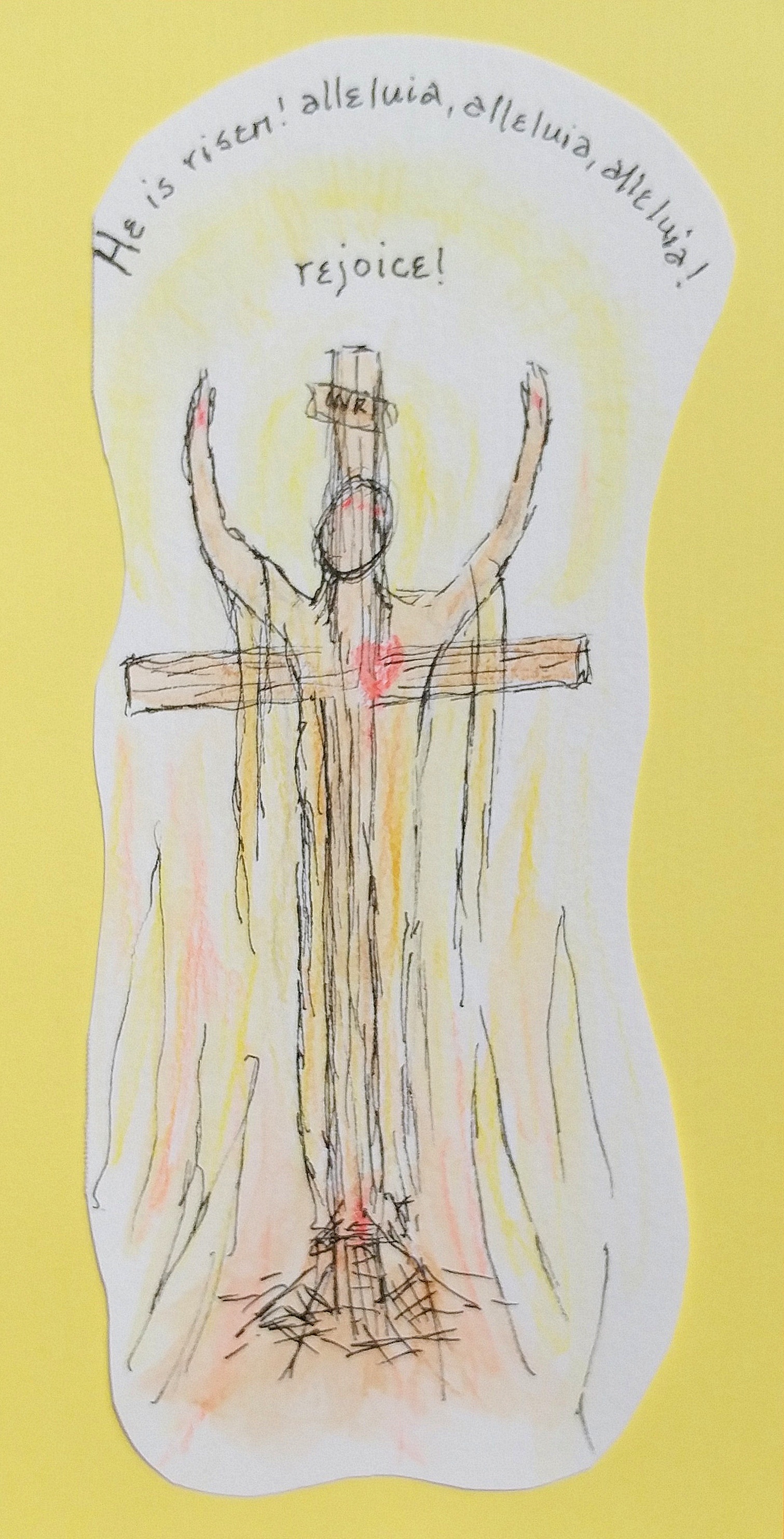
 A priceless thing...