Category Archives: Uncategorized

The Wrath of God

Wow. Scary title for a blog post, isn’t it? And not one you would expect from me.

But I write, of course, for a reason.

The fire and brimstone preachers preach it. Those who claim universal salvation deny it. And the rest of us cringe.

We cringe, perhaps, because we are afraid of such a wrath. Or perhaps because we do not know how we can reconcile the notion, to ourselves or others, with the all-loving, all-forgiving God we claim to know.

Yet it is pretty hard to deny the reality of this teaching. It is right there in the Bible, even in the New Testament, scribed by those who were witness to the fact that this very same God has died for us. How can this be?

I am no theologian or Biblical scholar. But today I was reminded of a casual conversation I had with someone a couple of months ago, in which the other was normalizing anger on the basis of Jesus getting angry when He upset the money changers’ tables in the Temple.

I had expressed some hesitation at comparing my anger to His anger. I couldn’t quite put it into words but I knew there was a difference.

Today, in a different context, with a different person, the topic rose again. And something came together a bit more in my mind.

When we, in our humanness, speak of “anger” and “wrath”, we are typically referring to deeply felt emotions. They are among the passions with which we struggle and they can easily overtake us, leading us into sinful behavior. It is because of these passions that we are wise to fast and pray, in hopes that we might receive the grace and wisdom to manage these natural but often love-threatening emotions.

Jesus, of course, was fully human and therefore felt all of the same emotions we do. However, I do not believe that Christ’s action with the money changers revealed Him being overtaken by passions, though the behavior might appear outwardly similar.

If Jesus was overcome by His passions, how readily I could then justify my own! “Even Christ got angry with unreasonable people sometimes, so it is normal for me to do so as well.”

What appears similar can be very different – and yet can be difficult to discern in our own lives. Jesus, I believe, was moved by His Spirit to speak Truth, in a commanding and authoritative manner.

He saw what the money changers were doing and the Spirit in Him could not watch and not speak Truth. He could not speak it quietly and calmly, in the same manner He might have said, “Your sins are forgiven” or “Your faith has saved you.”

The Truth is always loving. Sometimes it is a gentle whisper. But sometimes it is bold and strong.

We, as Christians, are given the Spirit of God. What is so difficult for us is to learn to discern when our passions are overtaking us, impelling us to say words or take actions not consistent with the Gospel, versus when the Spirit in us may be calling us to speak Truth.

This is more difficult than we might anticipate, because our emotions are so dear to us and they feel so “right”.

“Of course, God must want me to speak up about this wrong or correct this injustice.”

And our emotions are valuable and not to be quashed without reflection or regard.

However, it may be only some time after a reaction (if at all) that we are able to see how our behavior was, at best, ineffective, or worse, injurious, because it was ego-driven, not Spirit-driven.

Now, informed by our reflection on Jesus, let us return to the “wrath of God”.

I cannot say what the wrath of God is – but I will comment on what it is not. God’s wrath is not anger, the human emotion, the passion with which we struggle. If it were, we have a God who is no better than we are.

It almost seems an unfortunate choice of words to say “wrath”, because what else can our poor human minds conjure up but what we know? Perhaps we think of a father who came at us with the belt or a mother with the switch, screaming at us, out of control while we cowered.

The childhood remnants of “wrath”, in living color.

That is not our God.

Yet what word then can we use for God’s Truth? His Truth is always loving – He cannot not have (or be) a Truth that is inconsistent with Himself.

Whatever that word might be, His Truth cannot accept falsehood or lies. His Love cannot accept hate. His Good cannot accept evil.

His nonacceptance of these things is not a trifling preference. If it were, He would not have become incarnate, been crucified and raised from the dead to free us from them.

His “wrath” and His love are thus not in opposition to one another but work hand-in-hand for our good. There can be no good for us in falsehood, hatred and evil.

(I am well aware that using the word “nonacceptance”, sounds too weak, too soft – for God is the complete antithesis of falsehood, hatred and evil. But I choose this word so as to avoid the suggestion that God is ruled by the very emotions that plague His creatures.)

What does this “wrath of God” mean for the end times?

I have no idea. How could I, still ruled by the passions as I am, conceive of what this God of “loving wrath” will do in response to His creatures, each uniquely knowing (or not knowing), loving (or not loving), understanding (or not understanding) Him with varying degrees of capability and culpability?

Yet even though I do not know, I am not afraid. How could I be?

He has died to set me free from my very self. He has come to live within my heart. Whatever the “loving wrath” is, I long for it – because it is Him.

And He is my joy.

Evening prayer

I did something foolish on the way home from work today.

Actually, I did it twice.

But it almost seemed as though it would be more foolish, more risky not to do it. And so I did it.

As I often do, I was praying Evening Prayer (listening to the app on my phone, from divineoffice.org). I find it a peaceful way to prayerfully transition from work into the rest of my evening.

As I was listening to the psalms, these words particularly resounded in my soul:

“Our help is in the name of the Lord who made heaven and earth.”

Naturally, I have heard this antiphon from Psalm 124 many times before. But what occurred tonight was most astounding. For as I was gazing through my windshield, this was the heaven and earth that I saw:

evening prayer 4

The One who is my Help, the One who has enabled us to escape “the snare of the fowler” – He created all of this and more.

The antiphon kept repeating. I looked to my left.

evening prayer 5

Camera was not with me, being at home, asleep in his bag. But my cell phone has a camera…

I kept exhorting myself to pay attention to the road and the traffic.

“Our help is in the name of the Lord who made heaven and earth.”

I kept hearing the words and seeing their reality displayed before me. I wasn’t paying attention. I had to pull over.

So I paused the audio play of Evening Prayer on my phone, while my heart continued sing it. And my phone received these images.

Kind of foolish perhaps, to pull over onto the shoulder of a busy freeway to receive images of a sky set afire by the setting sun. But it might have been more foolish not to.

Considering this call to beauty complete, I reset the audio Evening Prayer, moving it back a little to hear the words that I had missed while parking. I pulled back into traffic…

“Praised be the God and Father

of our Lord Jesus Christ,

who has bestowed on us in Christ

every spiritual blessing in the heavens…”

(Ephesians 1: 3)

As I rounded the bend, trading one freeway for another, there was even more. It seemed I was being shown these spiritual blessings in the heavens. I don’t think I need to tell you what I did next…

evening prayer 2

“God has given us the wisdom

to understand fully the mystery,

the plan he was pleased

to decree in Christ,

A plan to be carried out

in Christ, in the fullness of time,

to bring all things into one in him,

in the heavens and on earth.”

(Ephesians 1: 8-10)

evening prayer 1

evening prayer 6

As Evening Prayer moved into the Responsory, my heart dropped and it was all I could do not to cry.

“Lord, you alone can heal me, for I have grieved you by my sins.

Once more I say: O Lord, have mercy on me,

for I have grieved you by my sins.”

The thought that my sins grieved the Lord God of heaven and earth seemed almost too much to bear.

But along with the compassion of the darkening sky, the antiphon for Canticle of Mary soothed me again:

“My soul proclaims the greatness of the Lord

for he has looked with favor on his lowly servant.”

I am certainly a much lowlier servant than her. And He has looked with favor on me. Not because I have earned it or done anything righteousness. Most certainly not.

I was simply driving home and His light and beauty and grace shown upon me.

Despite my sins.

Maybe even because of them.

How often, in our shame, we forget how very much God loves us, even in our sin, showering us with graces and inspirations and opportunities to find our way back to Him.

He knows how much we need Him. He never forgets us.

All praise to Him.


The little way

Over the last few weeks, my soul has been guided by one of the best spiritual teachers not on earth.

And today, we celebrate her feast day in the western Church.

St. Thérèse of the Child Jesus, known to many as “the Little Flower”, has been embraced by many people the world over since her canonization in 1925.

Many things make her story captivating. She entered a small, austere religious community at age 15, having traveled to meet the Pope to seek his permission the year before because of her youth. She lived an obscure life, seeking no attention for herself, dying of tuberculosis at age 24. In addition to her great physical suffering, she experienced extensive periods of spiritual aridity that she bore with peace, even joy.

We know of her and her “little way” to holiness only because she was ordered to write before she died – and she did so out of obedience. (O blessed obedience!)

As I began re-reading her autobiography in these recent weeks, I came to realize that I did not understand – or remember – what her little way really was. It sounds so simple that one can easily comprehend the meaning of the words. But to consistently live them is something else altogether.

I will allow her to explain:

St. Thérèse described the way of “spiritual childhood”, acknowledging that “I am but a weak and helpless child.” But as a child, she did not fret over her weaknesses but rather instructed, “let us in all humility take our place among the imperfect, and look upon ourselves as little souls who at every instant need to be upheld by the goodness of God.”

Thus, as a spiritual child, she knew she was going to stumble and be imperfect. And she had complete trust that she was loved by her Father. Yet there is more…

She wanted to show her love for her Divine Spouse but knew that she was not capable of great acts.

“But how shall I show my love, since love proves itself by deeds? Well! The little child will strew flowers . . . she will embrace the Divine Throne with their fragrance, she will sing Love’s Canticle in silvery tones. Yes, my Beloved, it is thus my short life shall be spent in Thy sight. The only way I have of proving my love is to strew flowers before Thee—that is to say, I will let no tiny sacrifice pass, no look, no word. I wish to profit by the smallest actions, and to do them for Love. I wish to suffer for Love’s sake, and for Love’s sake even to rejoice: thus shall I strew flowers. Not one shall I find without scattering its petals before Thee . . . and I will sing . . . I will sing always, even if my roses must be gathered from amidst thorns; and the longer and sharper the thorns, the sweeter shall be my song.” (emphasis mine).

As she tells of her life in the convent, she explains how she volunteered to assist the most difficult of elderly nuns so that she can smile sweetly when criticized. When falsely accused of some misdeed, she quietly accepted it. Irritated by another’s restless noise at prayer, she offered acceptance of this as a gift to her Beloved.

She also refused to indulge her small but powerful desires, e.g. to seek the attention of a superior or one of her sisters who was also in the community.

She practiced her little way day in and day out, with each little discomfort, inconvenience and sacrifice born out of love for the Savior, until “I have reached a point where I can no longer suffer, because all suffering is become so sweet.”

I have often been puzzled by some of the great saints of both Catholic and Orthodox traditions who not only patiently endure the suffering given them but actually seem to crave suffering or to take action to bring themselves more.

Is there not enough suffering that comes naturally with being human that we have to create more? Does not God want us to enjoy the beauty of the life He has given us? Does He really want us to damage our bodies with rigorous asceticism?

I am most certainly not holy enough to understand the graces given to these great saints. For surely this manner in which they enter into suffering is a grace, as peculiar as it may seem to many of us.

I can say this with some certainty because of this holy guide who has been teaching me these past few weeks with her little way.

If my heart is to be united to the heart of Christ, how could it not suffer? The love of the Savior is not a love of comfortable and sentimental emotion. It is a love that sacrifices, that suffers, that gives all.

My own small self (yes, I am learning just how small I am) cannot love like that. I am too weak and selfish. But perhaps He will help me empty my heart of self through these little acts, done out of love.

I am only capable of small suffering. I know this about myself – and then, only with His help.

Yet, if I persist in the little way of my teacher, my heart will become empty, making room that my Beloved might come and dwell there. From my small heart, He can thus bring the fullness of His love to my little corner of the world.

Is there anything more beautiful I could hope to do with my life?

+++

Quotes in this post were taken from The Story of a Soul: The Autobiography of St.Thérèse of Lisieux With Additional Writings and Sayings of St. Thérèse. The Kindle version of this book is available for free through Amazon (here).

 +++

Also, see companion piece at oholyearth.com for photo reflections. Blessings.

God gives us more

About a week ago, I started writing a post about the monarch butterflies but did not finish it. I do not recall what interrupted me – if it got too late or something else needed to be done.

I felt sure that I would go back to the article and complete it because this is migration season for my little friends. Each year I am entranced by the mystery of their great flight. It is a part of creation that I consider one of the proofs of the existence of God because it is such an “unnecessary beauty”.

With all of the atoms crashing into each other in the primordial soup, resulting in more and more complex creatures who adapt until the fittest survive, there is absolutely no reason, no excuse for something so beautiful and extraordinary to happen.

This time of flight is also an important time for my soul because the journey of the monarch is, for me, a reminder of our great journey toward God. We are inexorably drawn on a journey to a destiny we cannot conceivably know of our own accord. How can we possibly find our way?

And yet, the monarchs do. Every year.

Around the time I began writing the other post, I asked God if I could see a monarch that day and receive its image. I do not know why – it seems a rather silly prayer. I had not seen any in my yard for quite a while and I had worked so hard to create a habitat for them.

I kept one eye on the window. The weather was ideal – hot and sunny. Occasionally, camera and I wandered out into my yard expectantly. No flutter of orange wings.

Then suddenly I saw a quick dash of the majestic insect as it dipped over my neighbor’s fence, without even a pause at my blooming bushes.

Okay. God answered my prayer – sort of. But I couldn’t help feeling He had been rather stingy about it.

I got busy and distracted with a variety of other projects over the next few days and kept telling myself that I was going to finish my post. And I would write a little here and there. But something seemed stuck. Why was I not writing what I wanted to write?

Sunday night came and a friend told me some news that changed everything. (I did not know this news because I do not watch television.)

Now I must tell you that I am not a morning person. I wouldn’t mind being a morning person but I’ve become a night person and it is very hard to be both.

But that morning, Monday morning, I got up earlier than usual and drove to a lakefront park before going to work. Camera was by my side, ready to receive images like we never had before. And receive them we did.

Although I am still processing this extraordinary experience, already I know I have learned something very important. Previously, I had believed in the idea of it. I had even tasted it before. But now, now I know it.

And that is, when we pray, God listens and He always answers. And He often gives us immeasurably more than what we ask for. It may not come in the form we request or arrive at the exact moment we hope for – but He answers.

He listens to even the smallest of His children’s needs. And gives with an outpouring of His heart that should leave us never in doubt of His great and powerful love.

For what my friend had told me was that thousands of migrating monarch butterflies had been passing our area and were roosting at the lakefront, waiting for a storm to pass. They would likely be there until the morning air warmed enough for them to resume their flight.

And indeed, many were still there when camera and I arrived Monday morning.

Below is a little video I put together of our experience, along with a poem that was given to me in a previous September as I contemplated the great flight. (I will post individual photos at oholyearth.com so that you may download them if you wish.)

Be blessed, as I have been blessed, dear friends in Christ. Our God is so very good.

postscript: I wrote this post late last night, with the intention of proofreading and posting today. This morning, while on the phone, I was gazing out my window and saw one of the biggest and most beautiful monarchs ever in my garden. My first impulse was to drop the phone and rush out with my camera – but, of course, I knew I didn’t need to. I have many images. So I just feasted on its beauty, as it glided from flower to flower and even came near the window, as though to greet me before moving on…

I feel like talking…

Dear Readers,

This evening, I felt like sharing some Scripture and thoughts with you. I didn’t proof the recording (lest I be tempted to edit it obsessively), so please forgive any distracting background noises, excessive “ums” or whatever. Often I feel like writing but, tonight, my energy is low and I just wanted to talk with you. (Wish I could hear you talk back!)


May God be with you always.

An incidental post of poem

(I am currently taking a free online poetry workshop through the California Institute of the Arts. It is a ton of fun and one more way for me to waste time and not do the things I should be doing! I’d like to share a poem I just wrote in response to a prompt – because prompts, aka assignments, often push a person to write in ways that they would not usually, if left to their own inclinations. This particular prompt was to write a lipogram, i.e. a poem in which one restricts oneself to using only words containing a single vowel. I chose to use the vowel “O”. As I explored O-only words, the topic, which must have been lurking in my soul somewhere, began to emerge. I would enjoy any commentary that might develop – not as in “good poem” or “bad poem”, but whether it provoked any thought or soul-movement. It is, of course, a very different thing to author a poem than it is to read it. So, if you are inclined, let it bounce around for a while and comment if you wish – or not.)


“God’s so good”,

croons soft solo

comforts crowds forlorn.

monks vow cool grottos

gold cross sold to borrow

mood for noon or sloth.


“no – not good!” scoffs

bold son of strong throngs.

“bombs drop hollow horror.

cold world howls sorrow.”

droop, not bow, for doctor’s clock.

for poor told wormwood blossoms.


lost or torn, Book’s plot not known.

John’s Word, from womb to tomb, now

Son of Sorrow, holds root of rod or rot,

food, fool, forsook crown for thorns.

cock crows so cost of door most mock.

mob chops wood for scorn of “Lord”.


flood of blood stops on tomb’s cold brow.

fold flock sorrows, holds for tomorrow.

morn follows moon, fog prowls low,

torch longs slow, rock block worry to go.

knock cocoon door, no knob – so bloom –

song grown, Word known – flown to Joy.


Late have I loved you…

The feast of St. Augustine follows the feast of his mother, St. Monica – so beautifully and appropriately. She who was so devout prayed for years that he return to the Faith she had taught him as a child.

Augustine’s father was apparently more interested in his studies than his faith and Augustine soon became enamored of worldly things. However, he never stopped searching for the truth. While living in Milan, out of curiosity, he went to hear the sermons of St. Ambrose and eventually became convinced of the truth of Christianity.

This did not result in an automatic conversion for him, however, because he did not find it easy to give up the things of the world that were not good for his soul. And perhaps it is for this that he is best remembered and most loved. Who among us cannot relate to this struggle?

While his Confessions are now considered a classic, at the time they were written they were virtually scandalous in that his admission of struggle and weakness was uncommon among those who embracing the relatively new Faith known as Christianity.

Last night, as I listened to a recording of an excerpt from his Confessions, I was moved to tears. This morning, I wanted to read the words in my own voice. I share my recording with you here – but suggest that you too may find yourself wanting to read the words aloud, so as to enter “into the inmost depth” of your soul along with Augustine.


[Text:]

From the Confessions of Saint Augustine

Urged to reflect upon myself, I entered under your guidance into the inmost depth of my soul. I was able to do so because you were my helper. On entering into myself I saw, as it were with the eye of the soul, what was beyond the eye of the soul, beyond my spirit: your immutable light. It was not the ordinary light perceptible to all flesh, nor was it merely something of greater magnitude but still essentially akin, shining more clearly and diffusing itself everywhere by its intensity. No, it was something entirely distinct, something altogether different from all these things; and it did not rest above my mind as oil on the surface of water, nor was it above me as heaven is above the earth. This light was above me because it had made me; I was below it because I was created by it. He who has come to know the truth knows this light.

O Eternal truth, true love and beloved eternity. You are my God. To you do I sigh day and night. When I first came to know you, you drew me to yourself so that I might see that there were things for me to see, but that I myself was not yet ready to see them. Meanwhile you overcame the weakness of my vision, sending forth most strongly the beams of your light, and I trembled at once with love and dread. I learned that I was in a region unlike yours and far distant from you, and I thought I heard your voice from on high: “I am the food of grown men; grow then, and you will feed on me. Nor will you change me into yourself like bodily food, but you will be changed into me.”

I sought a way to gain the strength which I needed to enjoy you.
But I did not find it until I embraced the mediator between God and men, the man Christ Jesus, who is above all, God blessed for ever. He was calling me and saying: I am the way of truth, I am the life. He was offering the food which I lacked the strength to take, the food he had mingled with our flesh. For the Word became flesh, that your wisdom, by which you created all things, might provide milk for us children.

Late have I loved you, O Beauty ever ancient, ever new, late have I loved you! You were within me, but I was outside, and it was there that I searched for you. In my unloveliness I plunged into the lovely things which you created. You were with me, but I was not with you. Created things kept me from you; yet if they had not been in you they would not have been at all. You called, you shouted, and you broke through my deafness. You flashed, you shone, and you dispelled my blindness. You breathed your fragrance on me; I drew in breath and now I pant for you. I have tasted you, now I hunger and thirst for more. You touched me, and I burned for your peace.

The Beloved

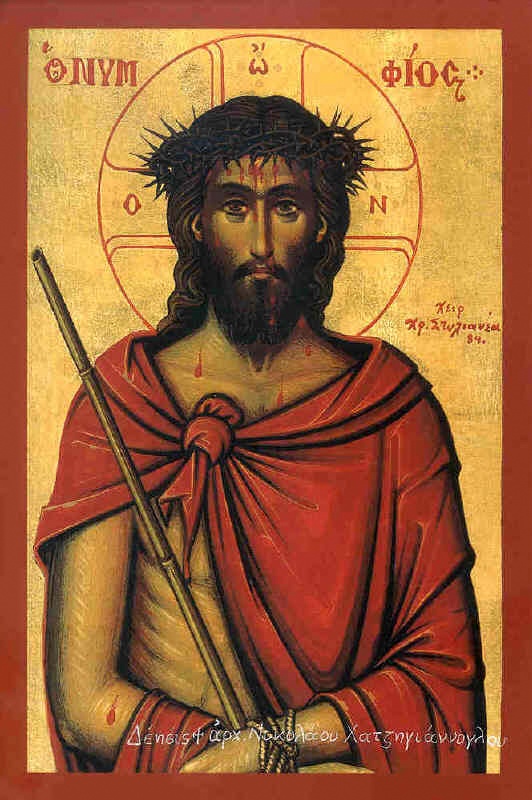
Christ the Bridegroom Icon
 

In the Roman Catholic tradition, we celebrated today the feast of St. Bernard of Clairvaux. I have recorded some beautiful words from one of his sermons about the love between Christ and the soul, the Bridegroom and the bride.

What he preached speaks so profoundly of this intimate love, this marriage between the Divine heart and the human heart, that I dare not try to add anything to it. Instead, I read, I listen and I pray.


Text: (from a sermon by St. Bernard of Clairvaux)

Love is sufficient of itself, it gives pleasure by itself and because of itself. It is its own merit, its own reward. Love looks for no cause outside itself, no effect beyond itself. Its profit lies in its practice. I love because I love, I love that I may love. Love is a great thing so long as it continually returns to its fountainhead, flows back to its source, always drawing from there the water which constantly replenishes it. Of all the movements, sensations and feelings of the soul, love is the only one in which the creature can respond to the Creator and make some sort of similar return however unequal though it be. For when God loves, all he desires is to be loved in return; the sole purpose of his love is to be loved, in the knowledge that those who love him are made happy by their love of him.

The Bridegroom’s love, or rather the love which is the Bridegroom, asks in return nothing but faithful love. Let the beloved, then, love in return. Should not a bride love, and above all, Love’s bride? Could it be that Love not be loved?

Rightly then does she give up all other feelings and give herself wholly to love alone; in giving love back, all she can do is to respond to love. And when she has poured out her whole being in love, what is that in comparison with the unceasing torrent of that original source? Clearly, lover and Love, soul and Word, bride and Bridegroom, creature and Creator do not flow with the same volume; one might as well equate a thirsty man with the fountain.

What then of the bride’s hope, her aching desire, her passionate love, her confident assurance? Is all this to wilt just because she cannot match stride for stride with her giant, any more than she can vie with honey for sweetness, rival the lamb for gentleness, show herself as white as the lily, burn as bright as the sun, be equal in love with him who is Love? No. It is true that the creature loves less because she is less. But if she loves with her whole being, nothing is lacking where everything is given. To love so ardently then is to share the marriage bond; she cannot love so much and not be totally loved, and it is in the perfect union of two hearts that complete and total marriage consists.

A little something new

Just a quick note to announce that I have started another blog. Guess I decided I didn’t have enough to do with just one. 🙂

This blog will continue as a place where I write in whatever way God directs me for as long as He directs me. To Him be glory.

The new blog is primarily for images. As its title suggests, it too is guided by the Spirit. With less emphasis on words, it is meant to move us through our eyes and hearts. You are welcome to take a look, though I’m just getting started:  oholyearth.com